
Straight answers
Straight Answers to the Questions We Get
Sawnee Land Clearing answers the questions landowners around Cumming and Forsyth County ask most: what clearing costs, how a forestry mulcher works, what grows back, when to clear, which permits apply and how to hire. Most wooded acres here cost $1,200 to $6,500 to clear, and clearing an acre or more needs a county permit.
- Cost per acre
- Mulching and regrowth
- Permits and Lanier
- Hiring right
FAQ
What people ask before they clear
Twenty-four questions in six groups. Each answer ends with a link to the page that covers it in full.
Cost
- How much does it cost to clear an acre of wooded land?
- About $1,200 to $6,500 or more, depending on what's growing on it. Around Cumming, light brush and saplings run $1,200 to $2,500 an acre, mixed pine and hardwood with trunks 4 to 8 inches runs $2,500 to $4,000, and dense hardwood, steep ground or rock runs $4,000 to $6,500 or more. A single acre usually lands in the upper half of its band, because the trailer trip costs the same for one acre as for five. Stumps pulled under a pad, grading and hauling go on their own lines. See what one acre costs.
- What does forestry mulching cost per hour or per day?
- About $150 to $300 an hour with an operator, or $1,800 to $3,000 for a full machine day. A 4-hour minimum is typical. Hourly pricing fits small, odd-shaped or open-ended work, where you pay for the hours the job takes. On a few acres of even brush, a per-acre price is easier to compare and puts the production risk on us. Rain days don't add to the bill: when the clay is soaked, the date moves and the rate stays. More on hourly and day rates.
- Is there a minimum charge for clearing a small lot?
- Yes. A half acre or less prices as a flat job, with a minimum of about $1,200 to $2,000. That covers hauling the mulcher to your lot and about half a day of machine time. A quarter acre rarely costs much less than a half acre, because most of the minimum pays for the truck, the trailer and the trip. Grinding stumps below grade is its own line at about $100 to $400 a stump. Coming out to look at a small lot costs you nothing. Read about small-lot minimums.
- Does Georgia cost-share pay for forestry mulching?
- Sometimes, on forest land. Georgia's Resilient Forest Incentives Program lists understory mulching on its schedule at $150 an acre, for brush under a standing forest canopy. Federal EQIP names practices such as Brush Management and leaves the methods to NRCS. Mulching to clear a house lot or a pasture falls outside both. Each program pays by its own schedule, never as a share of our price, so our quotes carry no reimbursement figure. The program office decides whether your job fits, and we confirm current terms with it before you apply. See cost-share and mulching.
Method
- What is forestry mulching, and is it worth it?
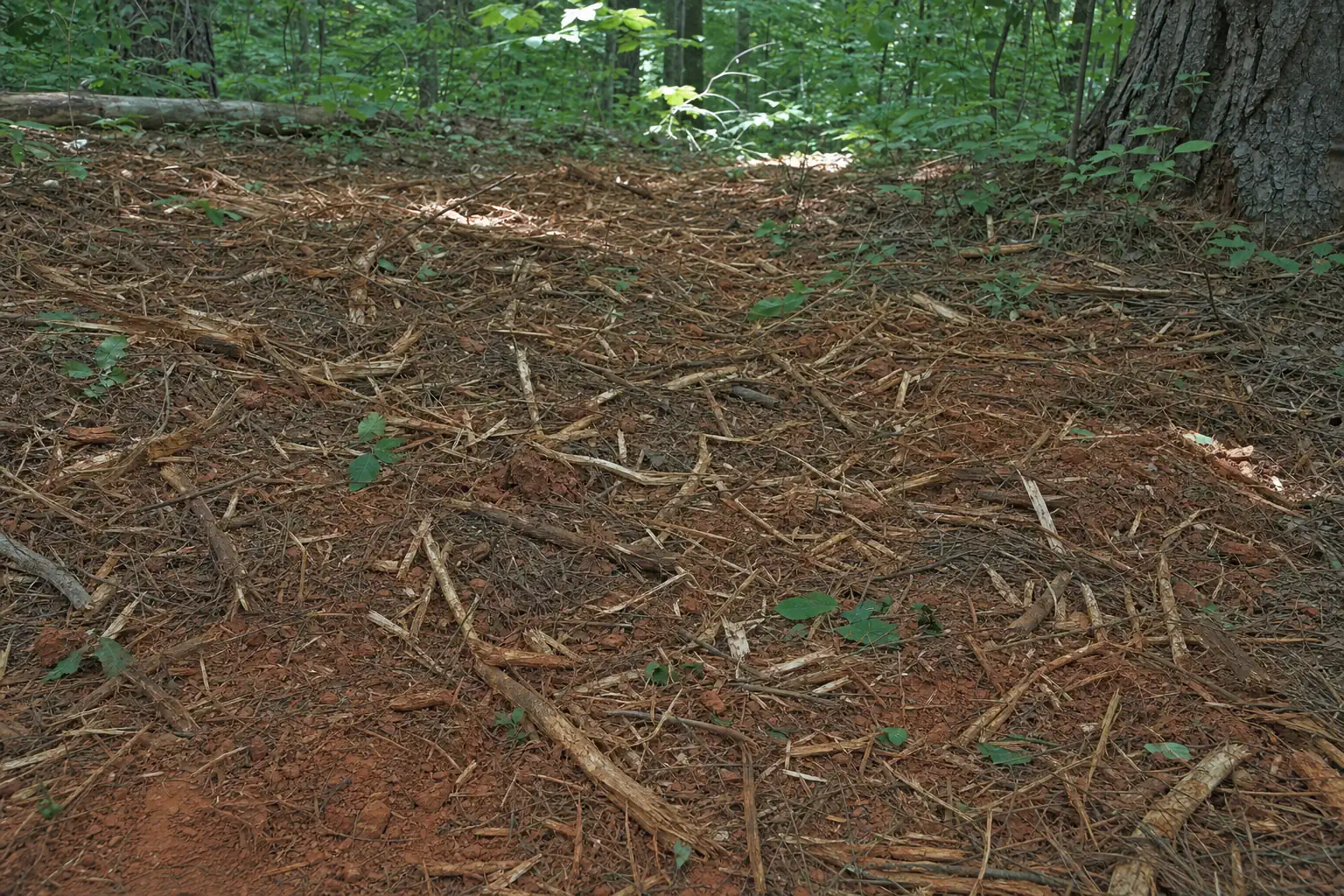
- A forestry mulcher is a spinning drum of teeth on a tracked loader or forestry tractor. It grinds brush and trees up to about 8 inches where they stand and leaves the chips on the ground, so nothing gets piled, burned or hauled. For land that stays woods, pasture, trails or a view, it usually pays: $1,200 to $6,500 or more an acre, against $3,500 to $8,000 to clear, grub and haul. Under a building pad it's the wrong tool, because those stumps have to come out. Read whether mulching is worth it.
- What size trees can a forestry mulcher handle?
- About 8 inches across at the trunk, standing. Past 8 to 10 inches, a tree gets felled first and the mulcher works the top and limbs on the ground. Or it stays, which is often the better call for a big hardwood. Trunk size matters more than species: a 6-inch pine and a 6-inch oak both mulch standing. Ground thick with 12-inch trunks prices in the heavy band, $4,000 to $6,500 or more an acre. For a quote, measure across the trunk at chest height or send a photo with a tape against it. See mulcher size limits.
- Does forestry mulching remove stumps?
- No. The mulcher grinds stumps down to ground level and the roots stay in the soil. That suits woods, pasture and trails, and a bush hog can cross the ground afterward. Where you'll run a finish mower or plant, stumps get ground below grade for about $100 to $400 each. Under a slab or driveway they come out with an excavator, and the holes get backfilled and compacted, because rotting roots leave voids that settle. We pull stumps only where the plan needs it. More on mulching and stumps.
- Do I need forestry mulching or bush hogging?
- Bush hogging if the land is grass, weeds, briars and soft first-year sprouts. Forestry mulching if saplings and trees have moved in. A bush hog is a rotary cutter behind a tractor, and it bounces off hardened woody stems; a mulcher takes trees to about 8 inches. Many owners around Cumming mulch once, then bush hog once or twice a year to hold the ground open. Mulching light brush runs about $1,200 to $2,500 an acre, and we quote bush hogging per visit after walking the ground. Compare mulching and bush hogging.
Regrowth
- Will the brush grow back after mulching?
- Yes. The mulcher grinds each plant off at the ground and leaves the roots alive, so sweetgum, maple, oak and privet sprout back the first spring. Cut pines don't come back. The chip layer slows the regrowth without stopping it. Mowing once or twice a year keeps mulched land open, and privet needs a dormant-season treatment by licensed applicators on top of the mowing. We set up that plan before the machine leaves, and maintenance mowing can run on the same contract. The full answer: will it grow back.
- How do I get rid of Chinese privet for good?
- Mulch or cut the privet, then have licensed applicators treat the regrowth with herbicide, usually twice. Mulching alone doesn't kill it, because the roots send up new shoots the next season. In a Forest Service study in North Georgia, mulching plus herbicide held privet to about 7 percent re-infestation after five years. Seed in the soil and berries from the neighbors' privet keep coming, so plan on a winter walk and spot treatment for a few seasons after the main work. Read about getting rid of privet.
- Does mulching kill kudzu?
- No. A forestry mulcher cuts the kudzu mat to the ground, but the root crowns survive, and kudzu roots reach 9 feet deep. Mulching is a good first step because it exposes the crowns. Then licensed applicators treat every crown in the growing season, while the vines are leafed out, and repeat it each year. UGA and the Georgia Forestry Commission put that at three to ten years. The patch is clean when no crown sends up runners through a full growing season. See mulching and kudzu.
- Should I spray after mulching, and when?
- Yes where privet or kudzu grew, and usually not for ordinary hardwood sprouts you plan to mow. Privet regrowth gets treated once it comes back even, in late fall or the dormant season, November through February. Spraying the day the mulcher leaves gives the applicator little to hit, since the roots haven't sent up new shoots yet. Forest Service trials found spring and fall treatments controlled 93 to 100 percent of privet, against 67 to 69 percent in summer. Licensed applicators do the spraying, following the label. More on spraying after mulching.
Timing
- When is the best time of year to clear land?
- Late fall through winter, for most land around Cumming. With the leaves off, rock, old fence and keeper trees show, and privet stands out green in the bare woods. The catch is wet red clay, which stops tracked machines after rain, and winter ground dries slower. Summer works on dry ground. Forsyth County bans land-clearing burns from May 1 to September 30, and mulching keeps running through the ban because nothing gets burned. Food plots run on their own clock: clear by July for a fall planting. See the best time to clear.
- Can you clear land in the rain or on wet red clay?
- Not when the clay is saturated. We keep working through a passing shower on firm ground, but soaked red clay won't hold a tracked machine without rutting, so we move the start date instead. Forsyth County gets roughly 50 to 55 inches of rain a year, and most of it lands on clay and slope. A wet week changes the date, and the price stays where the written quote put it. A bulldozer does no better on soaked ground: it ruts as deep and scrapes off the topsoil. Read about clearing on wet red clay.
- How long does it take to clear an acre?
- About half a day to a day for an acre of light brush. One mulcher clears roughly 1 to 3 acres a day of light brush and saplings, about an acre a day of mixed growth with 4 to 8 inch trees, and less than an acre of dense hardwood. An acre of hardwood with 12-inch trunks can take a day and a half or more. Trunk size and wet clay move the schedule more than acreage does, and a permitted site adds paperwork and silt fence before the machine starts. See how long clearing takes.
- Will the machines leave ruts?
- Not on firm ground. Forestry mulchers run on tracks that spread the machine's weight, and the machine drives on the layer of mulch it lays down. Ruts come from working saturated red clay, so when the ground is soaked we move the date. Expect faint track prints in the chips. We pick the route in on the walk, stay off the septic field and well, and keep the machine off soft ground near the trees you flag, since ruts in a root zone cut and pack the roots. More on ruts and clearing.
Rules
- Do I need a permit to clear land in Forsyth County?
- Yes, if the clearing disturbs 1 acre or more or sits within 200 feet of state waters. In unincorporated Forsyth County, clearing counts as land disturbance, and those jobs need a county land disturbance permit before work starts. The clearing and grubbing permit fee is $250. Smaller jobs away from water are exempt but still owe basic erosion control. Inside Cumming city limits, the city issues its own permit. A permitted site gets inspected on the permit's schedule, at least weekly on most sites, and within 24 hours of a half-inch rain. Read the Forsyth permit answer.
- Do I need a permit to remove trees on my own property?
- Usually not. Forsyth County's tree ordinance, amended April 2, 2026, exempts homeowners removing trees on their own property outside the required zoning buffer. Dead, diseased or infested trees are exempt with written confirmation from the Georgia Forestry Commission or the County Arborist. The answer changes once the job becomes land clearing: disturbing an acre or more, or working within 200 feet of a creek or other state waters, needs a land disturbance permit first. For a specific tree, ask the County Arborist. See tree removal permits.
- How close to a creek can I clear?
- Fifty feet from the stream, in most of unincorporated Forsyth County. The county keeps a 50-foot undisturbed buffer along streams, plus a 25-foot setback where nothing impervious goes. Georgia sets a 25-foot buffer on all state waters, and some water-supply watersheds go wider. Any clearing within 200 feet of state waters needs a county permit, even on a job under an acre. Inside Cumming city limits, the city sets its own buffers. We flag the buffer on the walk, and the machines stay out of it. Read about creek buffers.
- Can I clear my Lake Lanier lot down to the water?
- No. The shoreline between your property line and the water is federal land managed by the U.S. Army Corps of Engineers, and the Corps does not permit clearing it for views or lawns. Vegetation modification appears on the Corps fee schedule under grandfathered permits only, and new authorizations are not permitted. We underbrush and open lake lots on the Forsyth County side up to the government line, and our machines stop there. If the corner pins are missing, a surveyor sets the line first. See clearing to the water.
Hiring
- How do I know a company is really a forestry mulcher?
- Ask what machine comes to your land and what the ground looks like when it leaves. A forestry mulcher is a drum head on a tracked loader or forestry tractor that grinds standing brush and trees into chips and leaves them as cover. A plan built on burn piles or hauling everything off is a different job, and Forsyth County bans land-clearing burns from May 1 to September 30. Ask who runs the machine, too. Our jobs run on crews we schedule and manage under one contract, with one point of contact. Read how to vet a contractor.
- What should a land clearing quote include?
- The measured acreage, the trees that stay, what happens to stumps and debris, the finish, erosion control and the county permit. It should also say what the price leaves out. Two quotes to clear the same lot can describe two different jobs: one grinds stumps flush and leaves the chips, the other pulls stumps and hauls everything off. Without those lines on paper, you can't compare them. Our written quotes put each piece of the job on its own line, one business day after the walk. See what a quote should include.
- Can you keep the big trees and clear the rest?
- Yes. We walk the land with you, tie flagging on every tree that stays, and mulch the brush, privet and saplings around them. The mulcher grinds stems at ground level without digging, so the keepers' roots stay put, and the operator slows down near flagged trunks. Clearing under kept trees usually prices in the light band, about $1,200 to $2,500 an acre. The brush under them sprouts back the first spring, and a mowing pass once or twice a year keeps the woods open. Read about keeping the big trees.
- Do you handle the cost-share paperwork?
- Part of it. You file the application and the claim as the landowner, with the Georgia Forestry Commission or, for EQIP, your USDA Service Center, and the signature is yours. We handle the land side: the measured acres and a map of the stands, a quote with each practice on its own line, the current terms confirmed with the program office, and itemized invoices and photos for your claim. Sign-up for the Resilient Forest Incentives Program runs June 15 to July 3, so the measuring and the map come first. See who does the paperwork.
Ranges are estimates for Forsyth County and the surrounding area based on job density, terrain, access and acreage. Your written quote is the only price that applies to your property.
Permit thresholds, fees and buffer widths are those published by Forsyth County and the State of Georgia as of November 4, 2026. Confirm current requirements with the issuing authority before work begins. This is not legal advice.
Shoreline rules are set by the U.S. Army Corps of Engineers under the 2004 Shoreline Management Plan and were checked on November 4, 2026. A revision is in progress. Confirm with the Lake Lanier Shoreline Management Help Desk before any work near the government line.
Program figures and sign-up windows are set annually and are current as of November 4, 2026. We confirm every figure with the Georgia Forestry Commission or NRCS before any application. This page explains how programs work; it is not a guarantee of eligibility or reimbursement.
Who's asking
Answers sorted for your kind of land
Homeowners with acreage
Back acres opened, keepers kept, the permit question for under an acre.
Landowners and investors
Timber, thinning, privet programs and land you can sell or hunt.
Builders and developers
Permits, silt fence, inspections and a pad on your schedule.
Realtors
Frontage, lines and a building spot opened before the listing date.