
Permit guide · 8 min read
Do You Need a Permit to Clear Land in Forsyth County?
In unincorporated Forsyth County, clearing vegetation counts as land disturbance. Any clearing that disturbs 1 acre or more, or sits within 200 feet of state waters, needs a county land disturbance permit before work starts. Smaller jobs away from water are exempt but still owe basic erosion control. The county's clearing and grubbing permit fee is $250.
What the county counts as clearing
Forsyth County’s definition of land-disturbing activity names “clearing of vegetation” right beside grading, scraping, excavating and filling. A forestry mulcher working through brush and trees is land disturbance in the county’s eyes, even though it leaves a mulch layer instead of bare clay. The county’s rule is that all land-disturbing activity needs plan review and a land disturbance permit before work begins, unless the job falls under an exemption.
The same definition lists what it leaves out:
- Ordinary upkeep. Maintenance and landscaping, home gardens, and yard and grounds upkeep.
- Small house projects. Repairs, additions or minor changes to a single-family home.
- Firewood. Cutting firewood for your own use.
Taking an overgrown acre of privet and sweetgum back to usable ground is none of those. It sits inside the definition, so the real question on most jobs is whether an exemption covers it. The county issues permits through two departments; what a land disturbance permit is covers who does what.
The exemptions, and what each one comes with
Ordinance 73, the county’s soil erosion ordinance, follows Georgia’s Erosion and Sedimentation Act. Its Section III lists the work that can go ahead without a permit. These are the exemptions that come up on clearing jobs around Cumming:
| Situation | Permit needed? | What still applies |
|---|---|---|
| Clearing under 1 acre, more than 200 feet from state waters | No | The county’s minimum erosion practices. Not exempt if it’s part of a larger plan of 1 acre or more. |
| Clearing under 1 acre within 200 feet of state waters | Yes | Permit, erosion plan and buffers |
| Clearing 1 acre or more | Yes | Permit, erosion plan and state stormwater coverage |
| A single-family house disturbing under 1 acre | No | Trout-stream buffers, and not part of a larger plan of 1 acre or more |
| Agricultural operations | No | As state law defines them. Raising or boarding horses is excluded. |
| Forestry practices, including harvesting | No | Disturb a buffer and the whole property is barred from other land disturbance for three years |
Permit thresholds, fees and buffer widths are those published by Forsyth County and the State of Georgia as of November 4, 2026. Confirm current requirements with the issuing authority before work begins. This is not legal advice.
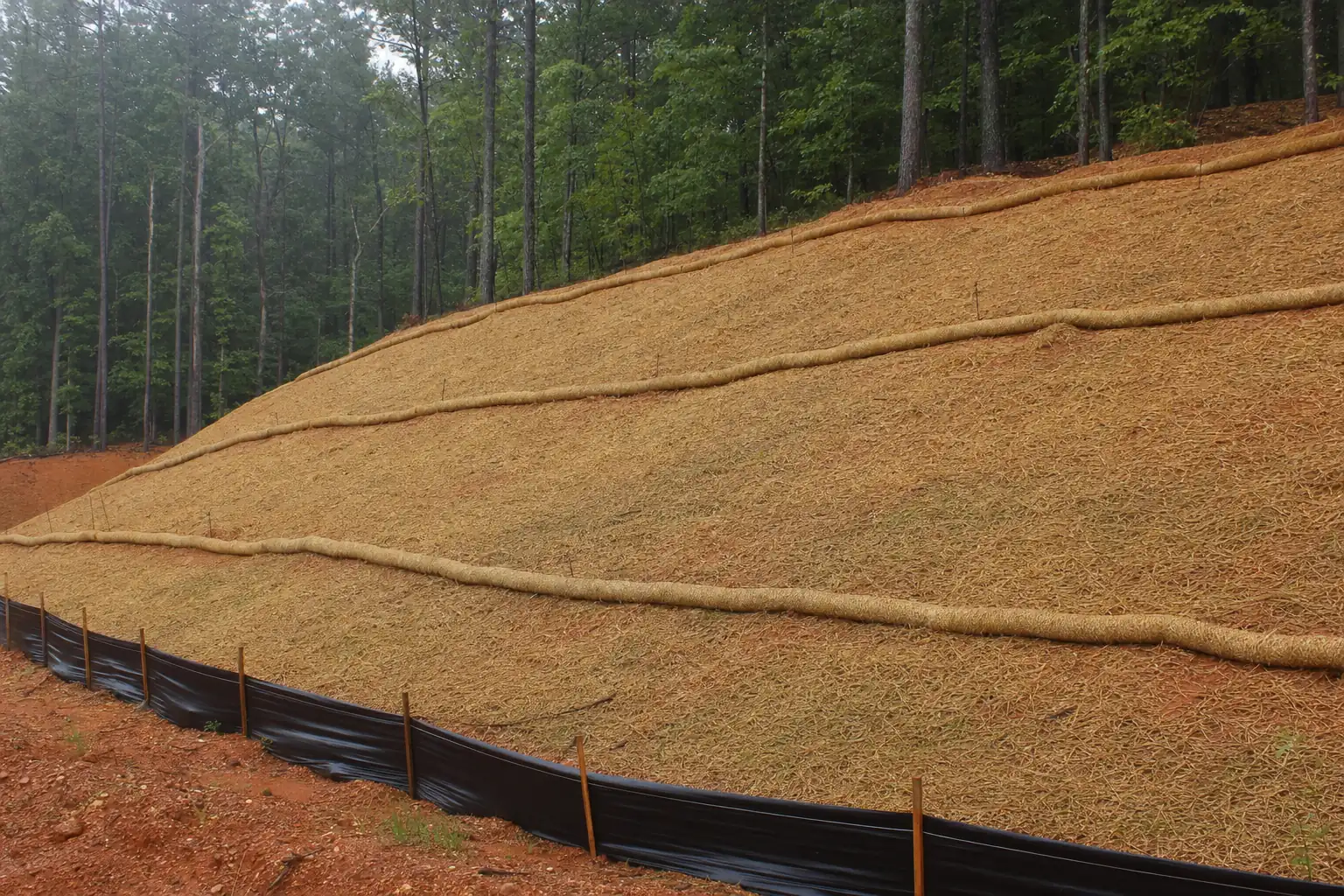
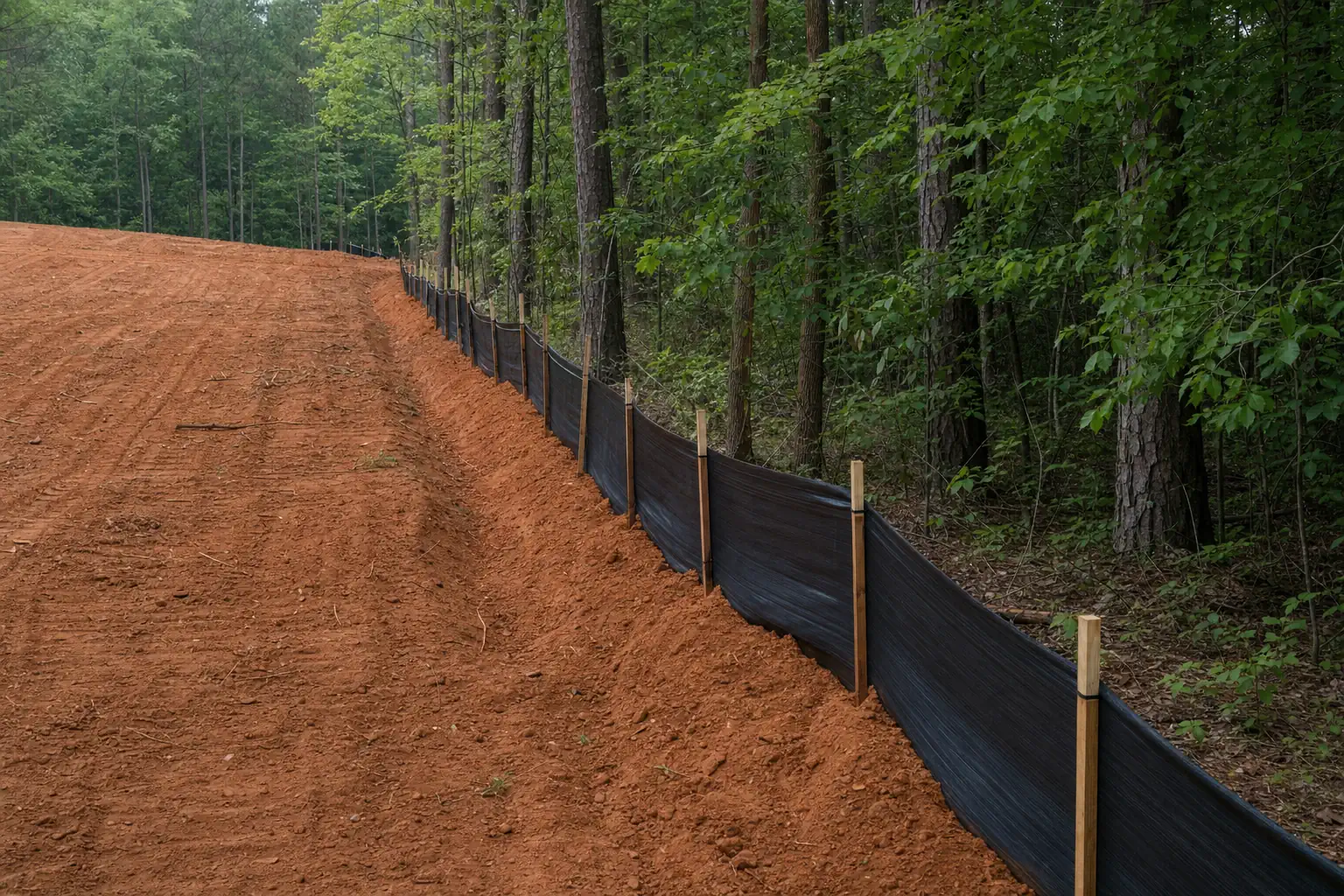
Exempt work still answers to the ordinance’s minimum erosion practices in Section IV. Sediment has to stay on your land whether or not a permit is involved. On a slope above a road, a creek or a neighbor’s yard, that usually means silt fence on the low side of a job the county never reviews. More in do I need silt fence for a small clearing job.
How the acre gets counted
The threshold is disturbed area, measured on the ground you clear. Your parcel size doesn’t set it. A half acre opened up for a house site on a 10-acre tract is a half-acre job, and 1.2 acres of a 2-acre lot is a permitted one.
The other half of the rule is the “larger common plan.” If the clearing is one part of a project that adds up to an acre or more, such as a subdivision, the county looks at the whole plan. Clearing it in pieces under an acre doesn’t change the answer, and we won’t quote a job that way. If you aren’t sure whether your project counts as one plan, ask the county before anyone starts; the contacts are on the county’s land disturbance permit page.
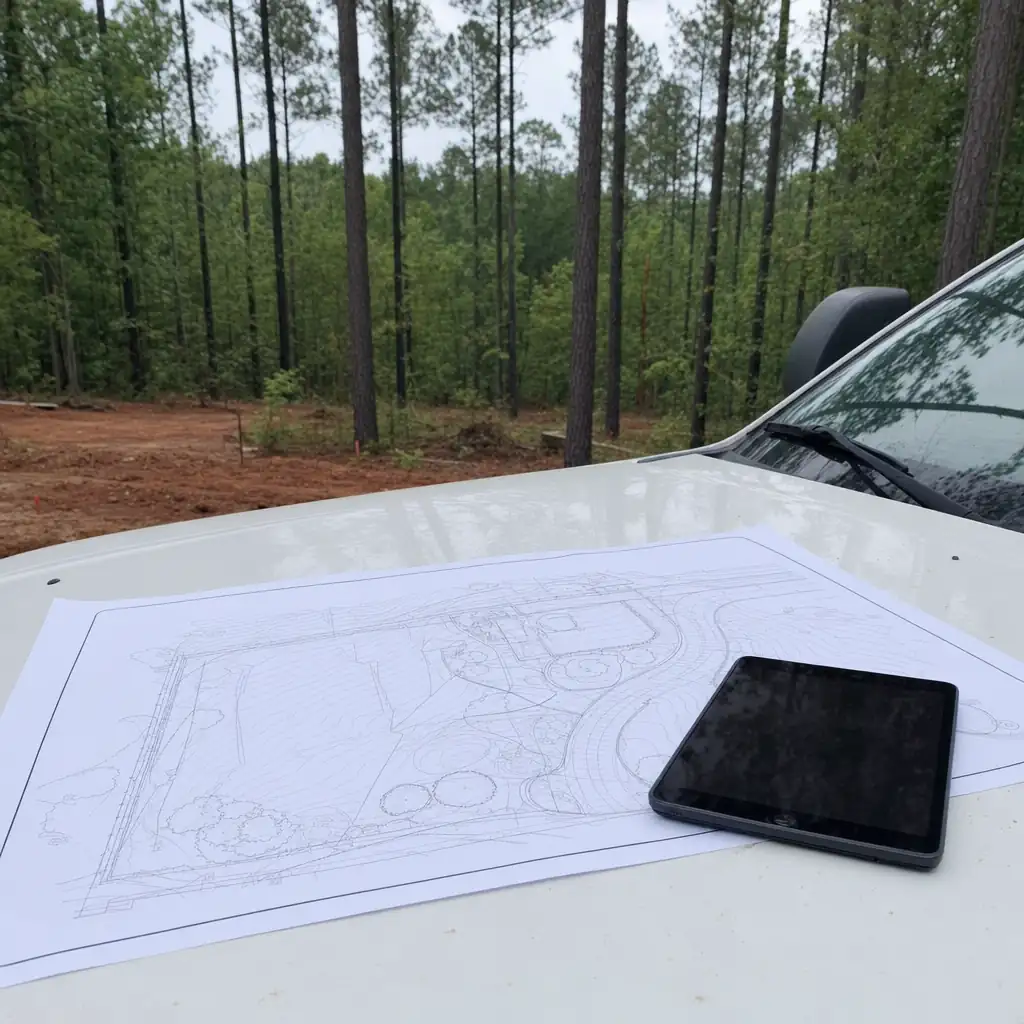
We measure the area on the walk-through and mark it on a sketch, so you know which side of the line the job sits on before you sign anything. The answer page on clearing less than an acre covers the small-job cases.
Why the 200-foot rule catches so many tracts here
The under-an-acre exemption ends at 200 feet from the bank of any state waters. In Forsyth County that reaches a lot of land. The east two-thirds of the county drains to the Chattahoochee and Lake Lanier, the northwest third to the Etowah, and creeks like Big Creek and Settingdown Creek collect a network of smaller branches on the way. A wooded tract with a hollow running through it often has water closer than the owner thinks.
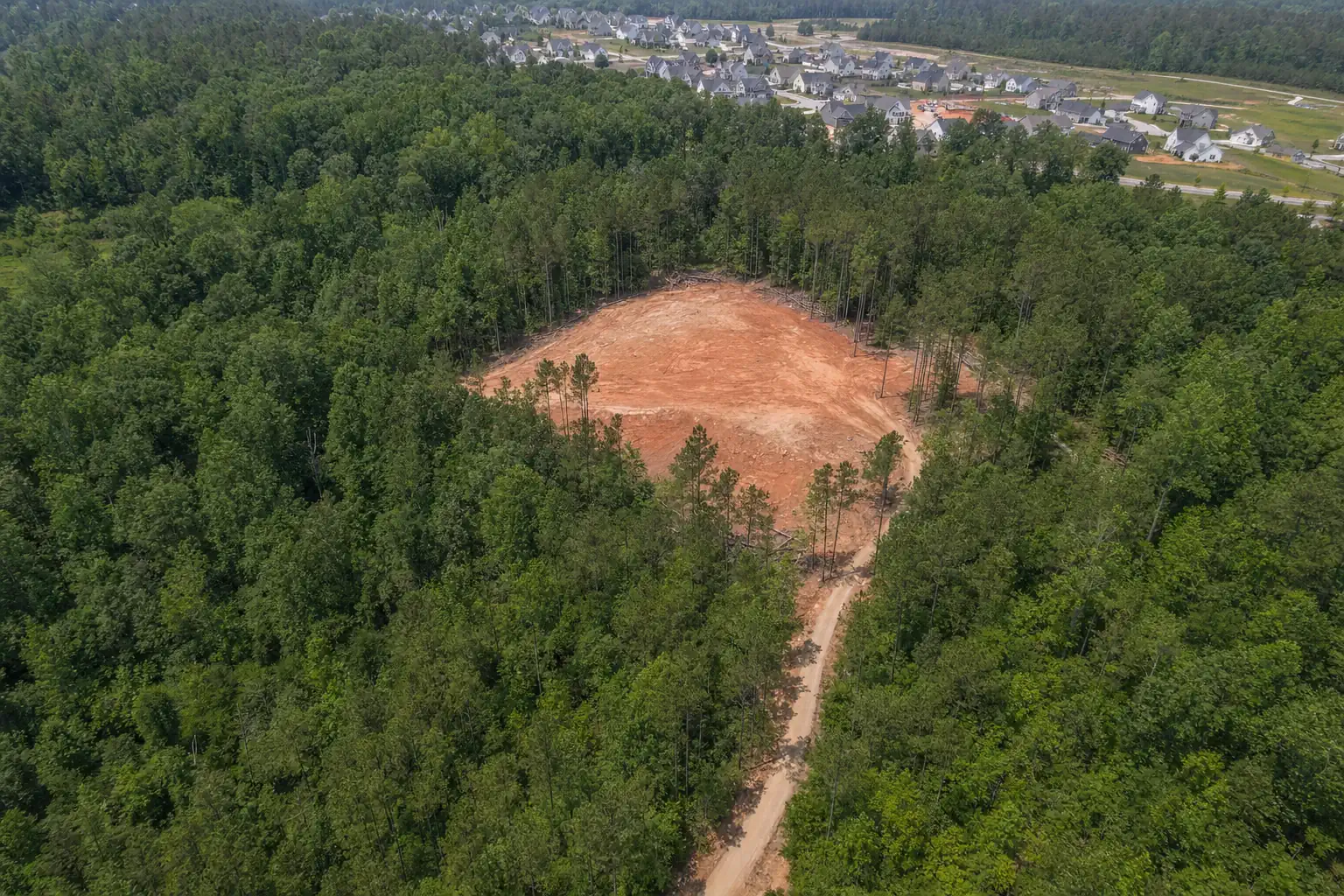
That distance is a permit trigger, and it’s a different number from the stream buffers. Georgia sets a 25-foot buffer along state waters, and unincorporated Forsyth adds a 50-foot undisturbed buffer plus a 25-foot impervious setback. Machines stay out of the buffers whether or not the job needs a permit. The full picture is in creeks, stream buffers and clearing near water.
What a permitted job needs before the first tree comes down
A permitted clearing job has paperwork in front of it, and the county’s process sets the order. The plans have to be a full civil set prepared by a licensed professional, with an erosion plan and a tree protection or replacement plan by a registered landscape architect, urban forester or arborist.
- 1Plans drawnYour engineer prepares the civil set, erosion plan and tree plan.
- 2County reviewPlanning and Community Development takes plans weekly and returns comments within nine business days.
- 3State coverageA Notice of Intent goes to Georgia EPD and the NPDES fee is paid before the permit issues.
- 4Pre-construction meetingThe Department of Engineering hands over the permit. Silt fence and exits go in, then clearing starts.
Your engineer or surveyor draws and submits the plans. Our part is building the controls the plan shows, clearing inside them and keeping them working. Once work starts, the site gets inspected at least weekly on most sites, and within 24 hours of a half-inch rain, and at least one person certified in erosion control has to be in responsible charge on site whenever land is being disturbed.
The figures that decide most jobs
Forsyth County clearing permit figures
- 1 acre
- Disturbance that triggers the county permit and state stormwater coverage
- 200 ft
- Distance from state waters where smaller jobs need a permit too
- $250
- County fee for a clearing and grubbing permit
- Up to $80
- State NPDES fee per disturbed acre
The $250 fee is the smallest cost of a permitted job. The engineering, the erosion plan and the silt fence cost more, and the review adds time to the schedule. Silt fence and erosion control run about $500 to $1,200 an acre on our quotes, as a line on the same contract as the clearing.
Ranges are estimates for Forsyth County and the surrounding area based on job density, terrain, access and acreage. Your written quote is the only price that applies to your property.
Property that needs a land disturbance permit also falls under the county’s tree ordinance, adopted April 2, 2026, which sets tree density units for the finished site. Homeowners removing trees on their own property outside the required zoning buffer are exempt from it. See removing trees on your own property.
Inside the City of Cumming
Everything above is the unincorporated county. Land inside Cumming’s city limits gets its land disturbance permit from the City of Cumming through its Planning and Zoning Department, under the city’s own fees and process. We don’t publish the city’s numbers here. If your address is inside the city, we confirm the current requirements with Planning and Zoning before we quote the permit line.
Common jobs, and where they usually land
Most calls we get fall into a few patterns. This is how they usually sort out under the county’s rules in unincorporated Forsyth. The measurements on the walk decide your job, and the county has the final word.
| Job | Usually | What decides it |
|---|---|---|
| Underbrushing half an acre behind a house, no creek nearby | Exempt | Silt fence still goes on the low side if the slope runs toward a road or a neighbor |
| Clearing a homesite of an acre and a half | Permit | Disturbed area over 1 acre |
| Clearing a lot under an acre with a creek at the back | Permit | Distance from the bank under 200 feet |
| Opening up 3 acres of old pasture before selling | Permit | Disturbed area over 1 acre, whatever the reason for clearing |
| One phase of a subdivision, under an acre on its own | Permit | Part of a larger plan of 1 acre or more |
A job that fits none of these rows gets the same check: send the address, and we measure the area and the distance to water on the walk.
Farm and forestry exemptions come with strings
The forestry exemption covers forest land management, including harvesting. It’s meant for land that stays in timber. Two rules make it a poor fit for anyone planning to build:
- The three-year buffer rule. If forestry work disturbs a stream buffer, the ordinance allows no other land-disturbing activity on the entire property, apart from normal forest management, for three years.
- The rezoning bar. The county’s tree ordinance guidance says property that has been clear cut isn’t eligible for rezoning for three years, and timber harvesting is permissible only in agricultural zoning districts.
The agricultural exemption follows the state’s legal definition of agriculture, and it leaves out raising and boarding horses. If the land is being cleared for a house, a driveway or a subdivision, the house rules apply, and we quote it that way. Clearing for food plots or timber stand work on land that stays in forest is a separate conversation; see hunting and timber land.
What clearing without a permit costs
Ordinance 73 puts real money behind the rules. The county can issue administrative fines of up to $1,000 a day per violation, or a Magistrate Court citation of up to $2,500 a day. The ordinance sets a floor of $250 a day for working without a permit and $1,000 a day where state or county buffers are impacted, plus revegetating the buffer.
The bigger cost is usually the stop. Work halts until the paperwork and the controls catch up, and a builder with a closing date can’t wait that out. That’s why we settle the permit question before the quote instead of after the clearing.
How we settle it on your land
On the walk-through we measure the area to clear, find the distance to the nearest creek or the lake, look at the slope and the low side, and ask what the land is for. Then the quote says one of two things:
- Exempt. The quote covers the clearing and any silt fence the slope calls for, and we start on a dry week.
- Permit needed. We work from your engineer’s plan, build the silt fence and construction exit it shows, and clear after the pre-construction meeting.
 Erosion Control and Silt Fence Installation
 Site Preparation: Pads, Driveways, Utility Runs, Staging
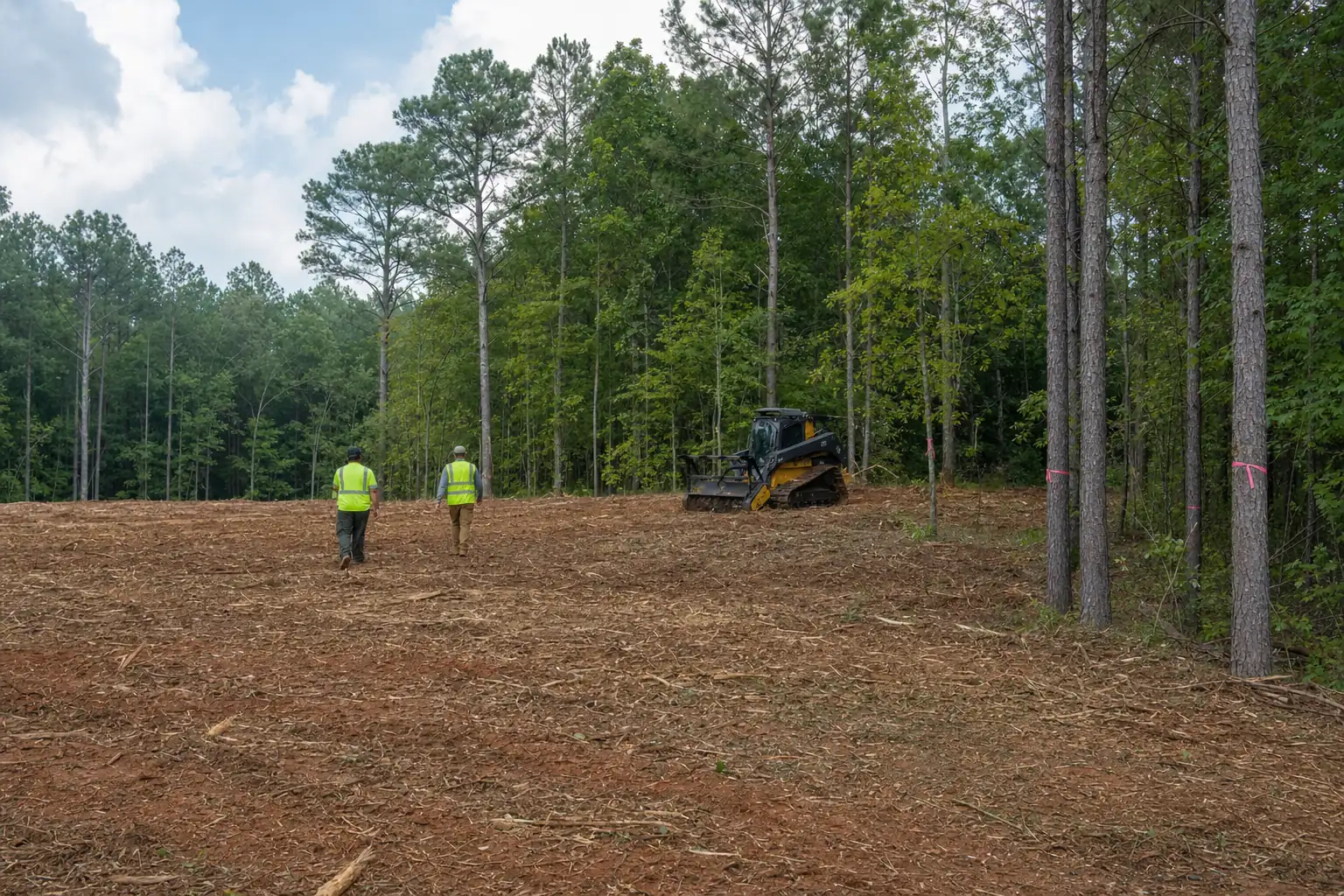 Lot Clearing for New Homes and Small Acreage
Either way, the land grows back. Brush and sprouts return within a season or two unless the ground gets built on or mowed, so plan for maintenance mowing. The rest of the erosion side, from silt fence to inspections, is on the erosion control and permits page and in erosion control requirements, explained.
Keep reading
Questions people ask next
- QWhat is a land disturbance permit and who issues it in Forsyth County?
- QDo I need a permit to clear less than an acre?
- QDo I need a permit to remove trees on my own property in Forsyth County?
- QHow close to a creek can I clear?
- QHow often are erosion control inspections required?
- QErosion control requirements, explained for landowners