
Erosion guide · 8 min read
Erosion Control Requirements, Explained for Landowners
Georgia's Erosion and Sedimentation Act and Forsyth County's erosion ordinance set the rules for clearing here. Disturbing 1 acre or more needs an erosion plan, a county land disturbance permit and state stormwater coverage, with inspections at least weekly on most sites, and within 24 hours of a half-inch rain. Smaller exempt jobs still owe basic erosion control.
Four layers of rules on one clearing job
A permitted clearing job in Forsyth County answers to a state law, a county ordinance, a state stormwater permit and a technical manual. They overlap, and each one adds something different to the job.
| Rule | Who sets it | What it asks of a clearing job |
|---|---|---|
| Erosion and Sedimentation Act of 1975 | State of Georgia | The base law. Sets the exemptions and lets EPD certify counties to issue permits. |
| Ordinance 73 and the land disturbance permit | Forsyth County, as the Local Issuing Authority | A permit before work on 1 acre or more, or within 200 feet of state waters. Buffers, penalties and minimum practices on every job. |
| NPDES construction stormwater permit | Georgia EPD | Coverage for 1 acre or more of disturbance, a Notice of Intent, a fee per acre and a regular inspection schedule |
| The Green Book | Georgia Soil and Water Conservation Commission | The design standard every erosion plan is drawn to |
Permit thresholds, fees and buffer widths are those published by Forsyth County and the State of Georgia as of November 4, 2026. Confirm current requirements with the issuing authority before work begins. This is not legal advice.
Inside the City of Cumming, the city issues its own land disturbance permit through its Planning and Zoning Department. The state rules still sit underneath it. Whether your job needs the county permit at all is covered in do you need a permit to clear land in Forsyth County.
The erosion plan and the Green Book
The erosion, sedimentation and pollution control plan is the drawing the whole job follows. On a permitted site it’s part of the civil set your engineer prepares, and it shows where the silt fence runs, where trucks enter and leave, which areas get cover and when, and where the stream buffers sit. The county reviews it before the permit issues.
The plan gets drawn to the Manual for Erosion and Sediment Control in Georgia, which everyone in the trade calls the Green Book. It gives the specs for silt fence, construction exits, slope cover and the rest, so a plan drawn in Cumming and one drawn in Macon use the same parts. Our job is to build what the plan shows, in the order it shows. More in what is the Georgia Green Book.
Exempt jobs don’t get a drawn plan, but the same parts apply. We place them from the slope and the low side we find on the walk.
What the rules put on the ground
Most of what an erosion plan asks for on a clearing job comes down to four things you can see from the road.
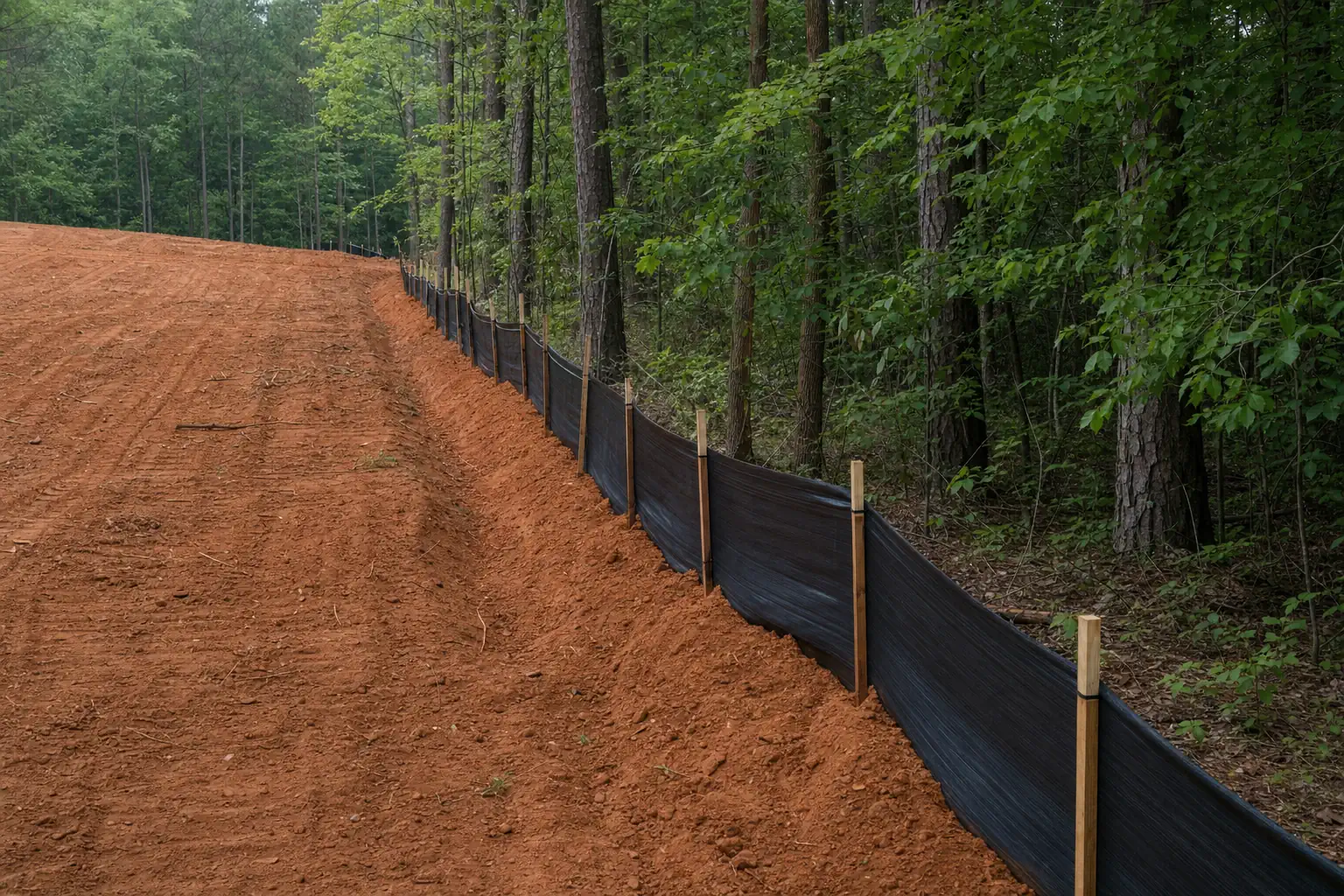
- Silt fence. Fabric trenched in and staked along the downhill edge, so runoff passes through it and leaves the clay behind.
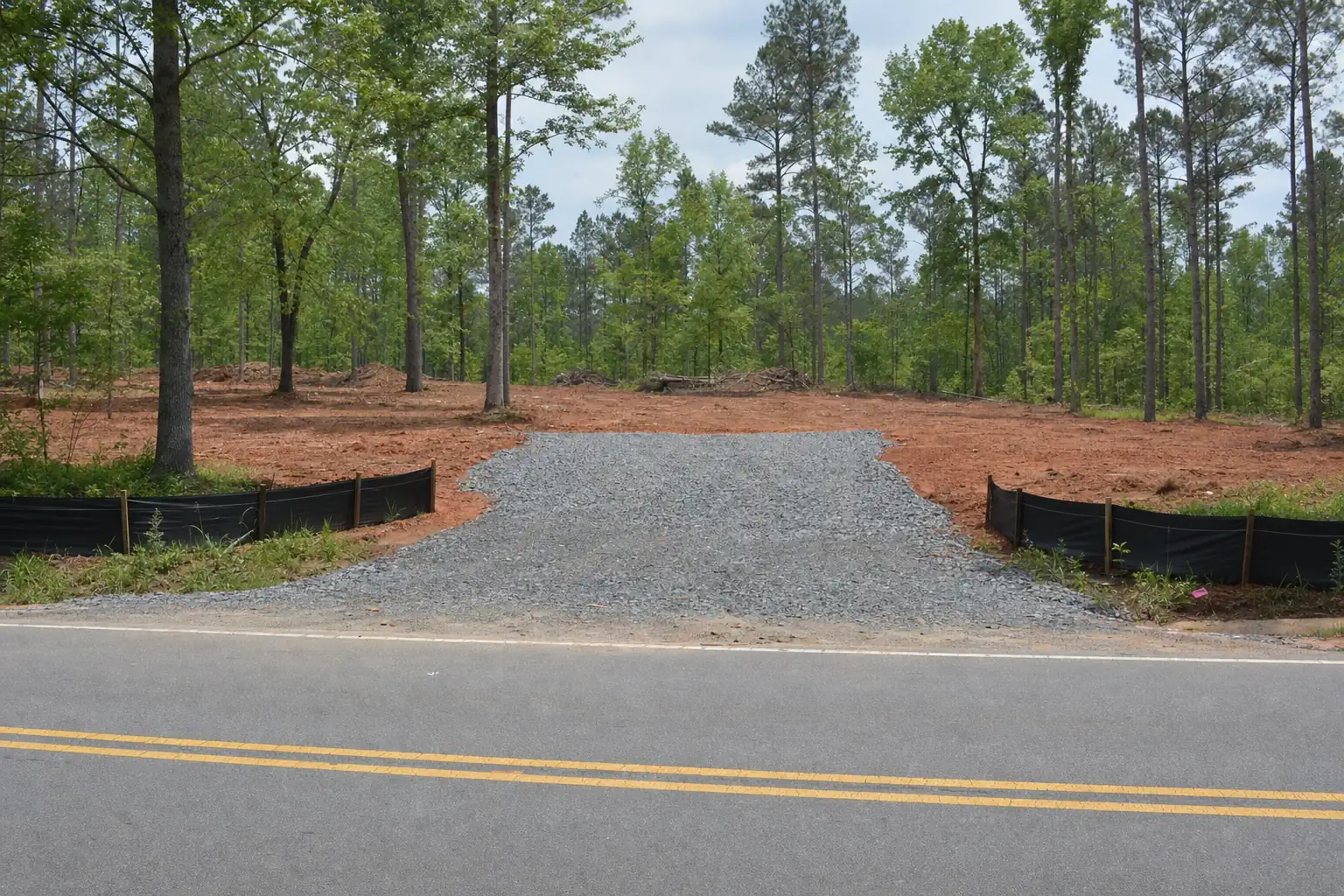
- A construction exit. A pad of stone where trucks reach the road, so clay comes off the tires before it reaches the county road.
- Cover on bare ground. Mulch from the clearing left in place, and straw on cuts and pads the grading leaves bare.
- Buffers left alone. The strips along streams flagged before machines arrive and left standing.
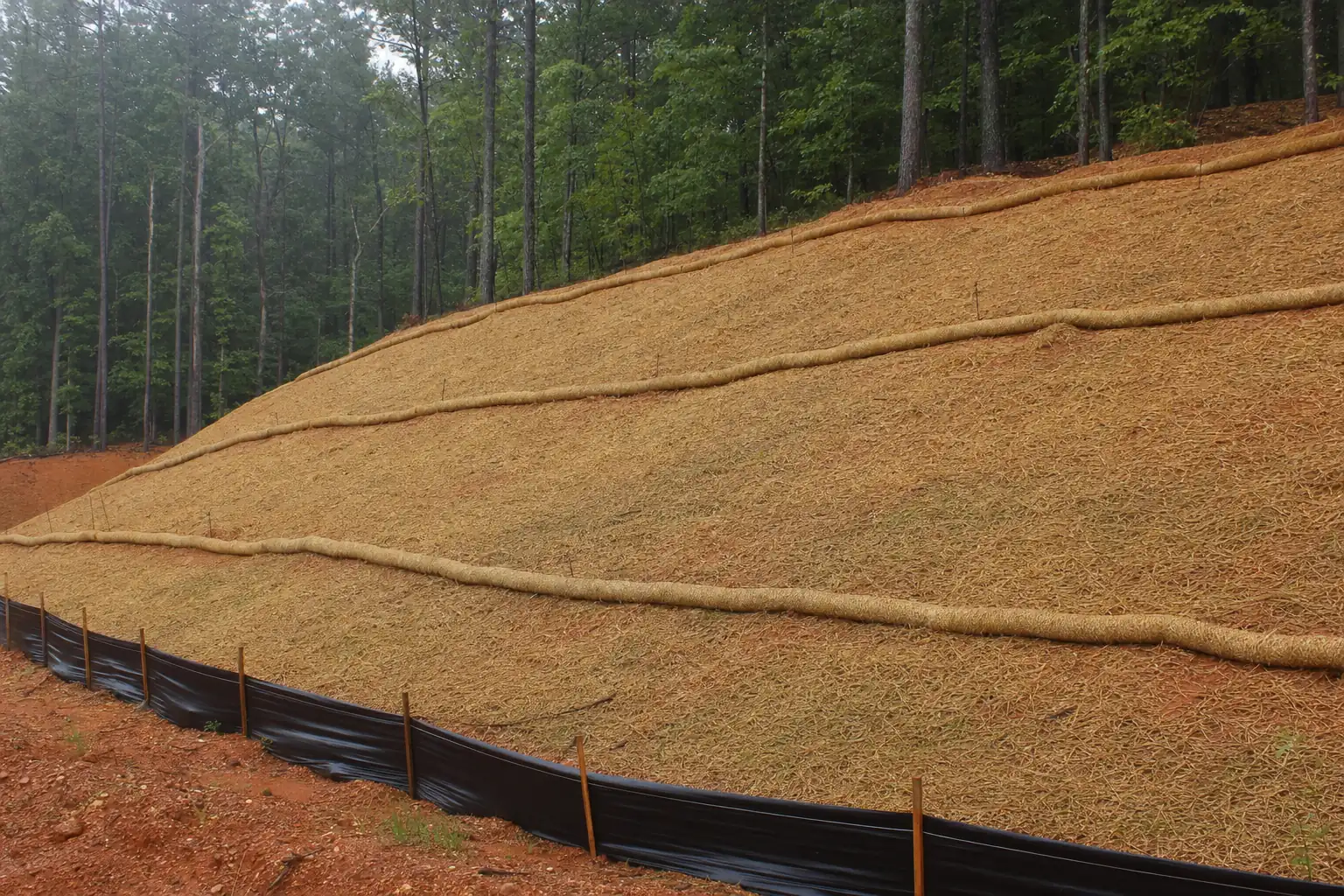
On our quotes, silt fence and erosion control run about $500 to $1,200 an acre, as a line on the same contract as the clearing.
Ranges are estimates for Forsyth County and the surrounding area based on job density, terrain, access and acreage. Your written quote is the only price that applies to your property.
Forestry mulching helps here. The mulcher leaves a mat of chips on everything outside the pad, the drive and the utility runs, so far less bare clay sits exposed to rain and the fence has less to catch. The silt fence and erosion control page shows how we install and keep each piece.
Inspections, and who has to be on site
A permitted site gets inspected on the permit’s schedule: at least weekly on most sites, and within 24 hours of a half-inch rain. Certified personnel do those inspections and keep the records. Between inspections, the controls have to keep working, which on red clay means walking the fence after heavy rain, cleaning out sediment and resetting any section that sags.
Georgia also sets training rules for the people on the job:
- Level IA Fundamentals. Each permittee needs at least one person in responsible charge of erosion control who holds this certification, and that person has to be on site whenever land is being disturbed.
- Subcontractor Awareness. Equipment operators and crews installing the controls under a permittee take this seminar. It doesn’t stand in for Level IA.
- Level II. The plan designers hold this one.
Forestry land management practices are outside the training requirement. A permitted clearing job for a house, a driveway or a development is inside it. The details are on how often erosion control inspections are required.
Who does what on a permitted job
Landowners often assume the clearing contractor pulls the permit and draws the plan. On a permitted site the work splits between several people, and it helps to know whose name is on each piece.
| Requirement | Who handles it |
|---|---|
| Civil plans, erosion plan and tree plan | Your engineer, with a registered landscape architect, urban forester or arborist for the tree plan |
| Plan review and the permit | Forsyth County Planning and Community Development reviews; the Department of Engineering hands over the permit |
| Notice of Intent and the NPDES fee | The applicant files with Georgia EPD before the county permit issues |
| Silt fence, exits and cover | The contractor, built to the plan |
| Inspections and records | Certified personnel, on the permit’s schedule |
When a builder hires us, the handoff runs both ways. You hand us the approved plan, the permit and a start date. We hand back a cleared site with the silt fence standing, the exit in working order, bare ground covered, and the buffers the way the plan left them. The builders and developers page covers how that fits a build schedule.
Why red clay and slope make this matter here
Forsyth County sits in the Piedmont, on red-clay subsoil over weathered granite and gneiss, and much of the land is ridge and slope. The county gets roughly 50 to 55 inches of rain a year. Scrape a slope down to bare clay and the first hard storm carries it downhill, into the road, the neighbor’s yard and the nearest creek.
That creek goes somewhere. The east two-thirds of the county drains to the Chattahoochee and Lake Lanier, the northwest third to the Etowah. Clay washed off a lot near Big Creek or Settingdown Creek ends up in water other people drink and fish. Flatter, sandier country doesn’t lose ground this fast, and that is why Georgia’s rules run strict and why we put the fence in before the first tree comes down. More on working this ground in mulching on red clay and slope.
Wet clay matters for the schedule too. Tracked machines on saturated ground leave ruts, and ruts channel the next rain straight down the slope toward the fence. We wait out wet weeks instead of tearing up the ground, which can move a start date. A site that stays open longer also needs more fence upkeep, so a dry-week start usually costs less on the erosion line as well. See clearing land on wet red clay.
The figures behind the rules
Erosion figures for clearing in Forsyth County
- 1 acre
- Disturbance that triggers the county permit and state stormwater coverage
- 25 ft
- Georgia's buffer along all state waters, 50 ft on trout streams
- 50 + 25 ft
- Forsyth County undisturbed stream buffer plus impervious setback
- Up to $80
- State NPDES fee per disturbed acre
Big residential projects carry one more limit. Since a 2023 amendment to Ordinance 73, residential developments of 25 acres or more can’t have more than 20 acres disturbed in any single contiguous area. On a large tract, that shapes the clearing schedule, and the clearing runs in the sections the plan sets out.
The buffers have their own guide, creeks, stream buffers and clearing near water, including where the measurement starts.
Jobs without a permit still owe the basics
A job under an acre and more than 200 feet from state waters doesn’t need the county permit. It still falls under the minimum erosion practices in Section IV of Ordinance 73, so the sediment has to stay on your property. On a flat half acre of underbrush with a mulch layer left behind, that takes very little. On a sloped lot above a road or a creek, it means silt fence on the low side and cover on anything left bare. See silt fence on a small clearing job.
Any job that pulls stumps or grades also moves earth. We call Georgia 811 before grubbing or grading, with at least three business days’ notice. Mulching standing brush doesn’t dig. More in calling 811 before land clearing.
When the controls fail
Ordinance 73 backs the rules with fines: up to $1,000 a day per violation administratively, or a Magistrate Court citation of up to $2,500 a day. The minimum is $250 a day for working without a permit and $1,000 a day where state or county buffers are impacted, plus revegetating the buffer. The ordinance also requires stabilizing any disturbed area left idle for more than 7 days.
In practice, a failed inspection stops the job until the controls are fixed. Three things cause most failures on clearing jobs:
- Fence installed after the clearing. The first rain moves clay before the fence goes in.
- Fence nobody walks. A section knocked flat by a storm and left down lets sediment through until someone notices.
- Clay on the road. No construction exit, or one that’s buried in mud and never topped up.
A single-machine operator who clears and leaves the fence to someone else invites all three. We run the clearing and the erosion control on one contract, so one crew answers for both.
How we run the erosion side of a job
- 1Walk the low sideWhere water leaves the land, the nearest creek and where trucks will enter.
- 2Controls firstSilt fence and the construction exit go in before any clearing.
- 3Keep them workingFence walked after big rains, sediment cleaned out and sections reset.
- 4Stabilize and hand backBare ground covered, then the fence comes out once the ground holds.
Erosion Control and Silt Fence Installation Site Preparation: Pads, Driveways, Utility Runs, Staging
 Commercial and Development Clearing
Cleared ground holds better once something grows on it, and it also grows back. Brush and sprouts return within a season or two unless the land is built on or mowed, so plan for maintenance mowing. The other rules for clearing here, from the Corps line on Lake Lanier to the summer burn ban, are on the erosion control and permits page.
Keep reading
Questions people ask next
- QWhat is the Georgia Green Book?
- QHow often are erosion control inspections required?
- QDo I need silt fence for a small clearing job?
- QWhat is a land disturbance permit and who issues it in Forsyth County?
- QDo I have to call 811 before land clearing?
- QDo you need a permit to clear land in Forsyth County?