Straight answer · 3 min read
Does Forestry Mulching Kill Kudzu?
No. A forestry mulcher cuts the kudzu mat to the ground, but the root crowns survive, and kudzu roots reach 9 feet deep. Mulching is a good first step because it exposes the crowns. Then every crown needs herbicide treatment in the growing season, repeated for three to ten years, according to UGA and the Georgia Forestry Commission.
A kudzu plan for every year of it, in one business day.
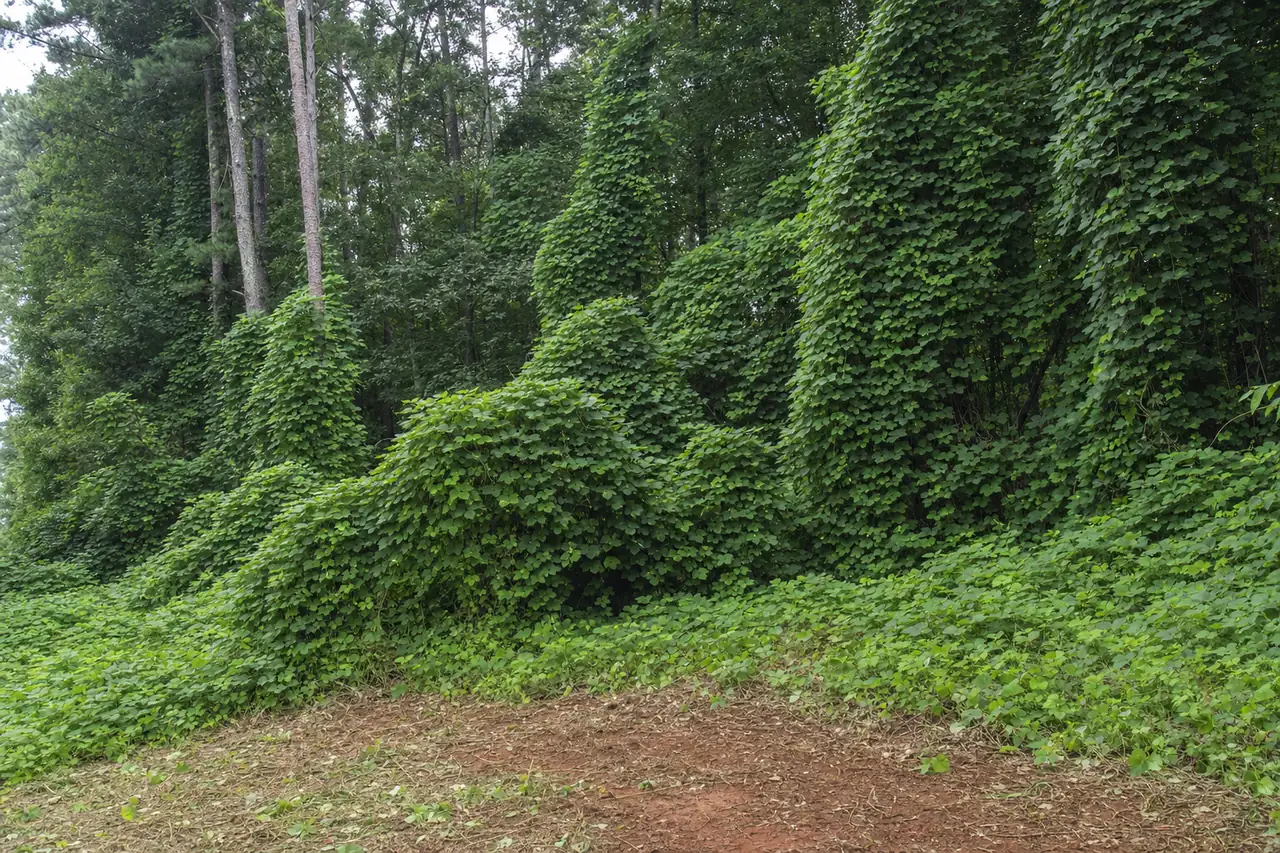
Kudzu on a road bank or a back slope in Forsyth County looks like something a big machine should finish in a day. The machine does finish the part you can see. What keeps kudzu alive sits at and below the soil surface, out of reach of any mulching head.
How kudzu survives the mulcher
Each kudzu plant grows from a root crown at the soil surface. The roots below it run as deep as 9 feet and hold a large store of starch. UGA and Georgia Forestry Commission guidance explains that this stored food is what lets kudzu regrow after mowing or grazing, and why control is hard.
- The crowns stay. A mulcher cuts the vines at the ground and grinds them. The crown sends out new runners from the starch stored in its roots.
- The vines root as they go. Runners put down roots at their nodes, and those become new crowns. A mature patch can have a crown every square foot or two.
- The vines grow fast. Georgia guidance puts vine growth at up to 50 feet in a single growing season, so one missed crown can cover ground again quickly.
Every crown in the patch has to be controlled. Miss a few, and they undo the work on the rest.
What mulching does for a kudzu job
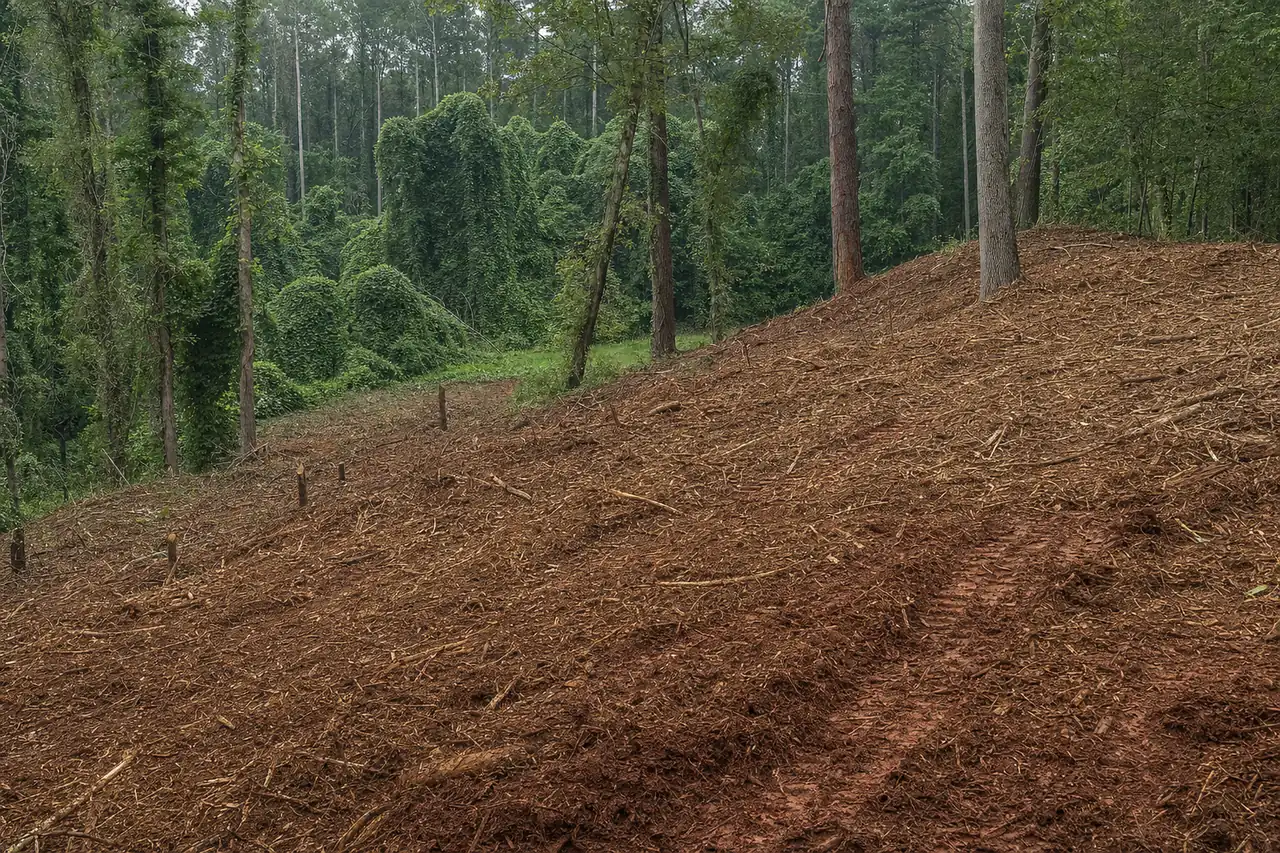
Mulching is still the right first step, and Georgia’s forestry guidance calls mowing a good first step toward control. Cutting the mat to the ground does four useful things:
- It shows you the crowns. The applicator can see what has to be treated.
- It shows you the hazards. A kudzu mat can hide gullies, ditches, logs and old wells. We find them before anyone walks the patch with a sprayer.
- It frees the trees. Vines climbing the edge trees get cut low, so the tops die off in the canopy.
- It makes the regrowth reachable. Treating fresh runners is far easier than spraying a mat draped over trees and fences.
The years after the machine
Kudzu is a multi-year job. UGA and the Georgia Forestry Commission put complete eradication at three to ten years of repeated treatment.
- Up to 9 ft
- How deep kudzu roots run
- 3 to 10 years
- Repeated treatment for complete eradication
- Every crown
- What has to be controlled in the patch
Herbicide applications are performed by licensed applicators in accordance with the product label.
The pattern runs like this. The machine cuts the patch down. Licensed applicators treat the runners from each crown in the growing season, while the leaves are out, since kudzu drops its leaves after the first hard frost. Crowns that survive get treated again the next year, with fewer to find each time. When no crowns sprout through a full season, the patch is done, and mowing keeps the ground open from there. Herbicide follow-up after clearing covers the timing in detail.
Slopes, clay and water
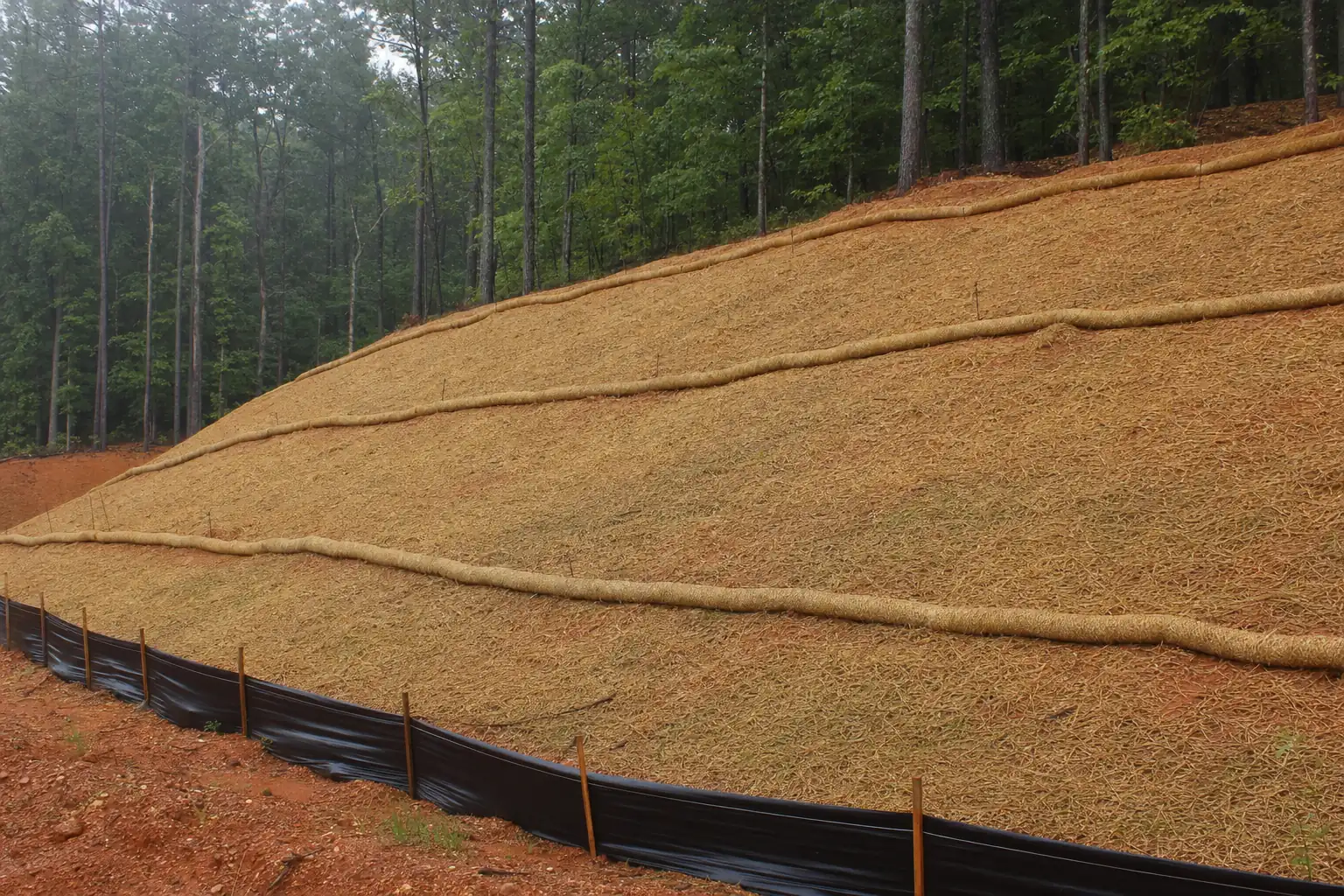
Kudzu was planted across the Southeast to hold steep banks, ditches and gullies, which is why so much of it sits on road cuts and ravines today. When it dies back, the red clay under it is bare. On a slope, we straw and seed the ground so it holds through the rain while the treatments run. Where a patch drains toward a creek, silt fence runs about $500 to $1,200 an acre, and the stream buffers decide where the machine can go.
Ranges are estimates for Forsyth County and the surrounding area based on job density, terrain, access and acreage. Your written quote is the only price that applies to your property.
Georgia guidance also lists grazing and prescribed fire as kudzu tools. Grazing takes fencing the whole patch for several seasons. We don’t burn, and Georgia bans outdoor burning in Forsyth County from May 1 to September 30.
What it costs
Mulching vines and light brush runs about $1,200 to $2,500 an acre around Cumming, with a $1,200 to $2,000 minimum for small jobs and machine time at $1,800 to $3,000 a day on steep banks and odd shapes. Herbicide treatments are quoted per season, and they get smaller as the crowns die out. Georgia’s Invasive Plant Control Program reimburses qualifying forest landowners for control that combines mechanical treatment with herbicide, and we confirm the current terms with the program office before any application.
Program figures and sign-up windows are set annually and are current as of November 4, 2026. We confirm every figure with the Georgia Forestry Commission or NRCS before any application. This page explains how programs work; it is not a guarantee of eligibility or reimbursement.
The full program is on the kudzu removal page, and the invasive plant removal hub covers privet and the rest. Once the kudzu is gone, plan on maintenance mowing to keep the ground open.
FAQ
More about mulching and kudzu
- Will mowing kudzu every year kill it?
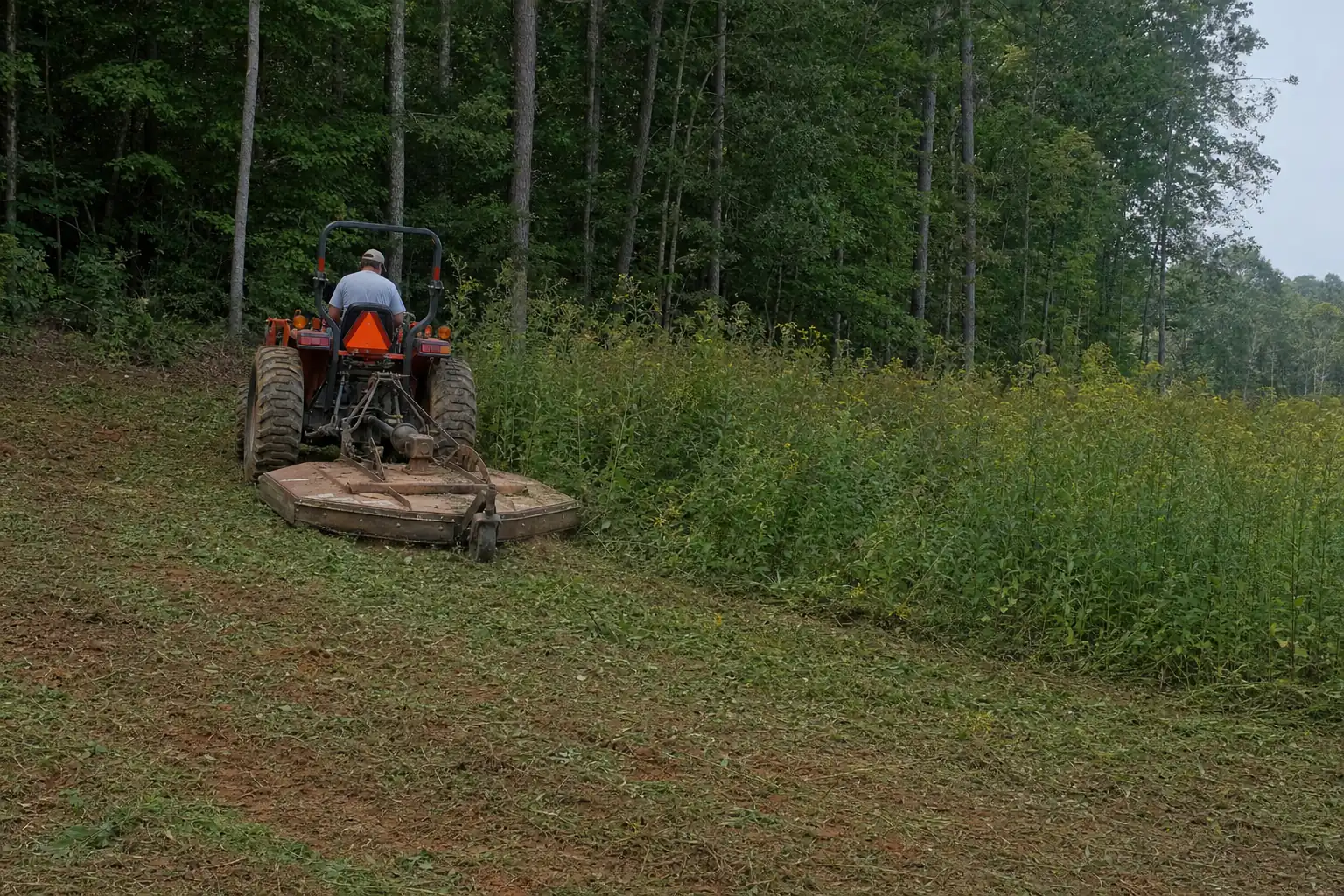
- Repeated mowing weakens kudzu over time, and Georgia guidance calls it a good first step. On its own it takes many seasons, and steep banks are hard to mow safely. Mowing plus treatment of every crown is faster.
- When should kudzu be treated?
- In the growing season, while the vines are leafed out. Kudzu drops its leaves after the first hard frost, so winter treatment of the leaves doesn't work. Licensed applicators treat it each year until no crowns sprout.
- Can I clear kudzu in the winter?
- Cutting in winter works, and leaf-off shows the ground, the crowns and anything buried under the mat. The treatment still waits for the vines to leaf out the next growing season.
- How do I know when the kudzu is gone?
- When no crowns send up runners through a full growing season. Each year there are fewer to find, and we walk the patch each season until it stays clean. From then on, mowing keeps the ground open.