
Straight answer · 3 min read
How Much Does Forestry Mulching Cost Per Acre in Georgia?
About $1,200 to $2,500 an acre for light brush, privet and saplings, $2,500 to $4,000 for mixed growth with trees 4 to 8 inches across, and $4,000 to $6,500 or more for dense hardwood. Those are Sawnee Land Clearing's estimates around Cumming, Georgia. Small jobs carry a $1,200 to $2,000 minimum.
Forestry mulching gets priced by the acre once a job is big enough to measure that way, and the price per acre runs about five times higher on dense hardwood than on privet. The ranges below are for North Georgia, built for Forsyth County and the towns around it. Here is what puts your land in one band or another.
The bands, by what’s growing
| Band | What you’d see walking it | Per acre |
|---|---|---|
| Light | Briars, privet, vines and saplings under 4 inches | $1,200 to $2,500 |
| Medium | Mixed pine and hardwood, trunks 4 to 8 inches | $2,500 to $4,000 |
| Heavy | Dense hardwood 8 to 12 inches and up, slopes over 15 percent, rock | $4,000 to $6,500+ |
| Small jobs | About a half acre or less, priced flat | $1,200 to $2,000 |
Ranges are estimates for Forsyth County and the surrounding area based on job density, terrain, access and acreage. Your written quote is the only price that applies to your property.
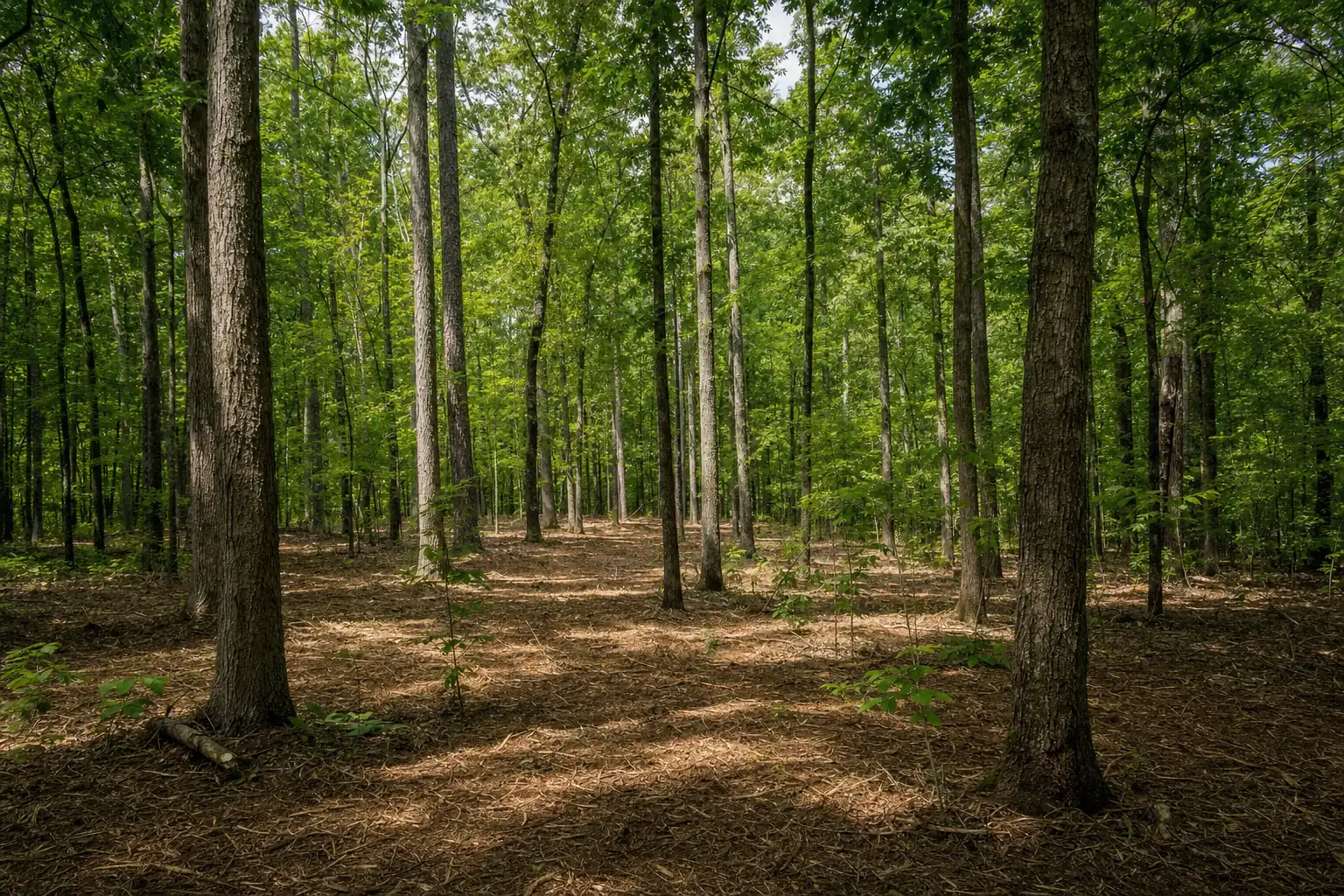
The light band applies on about three acres and up. Most underbrushing and old-pasture work lands there. House lots in mixed woods usually price in the medium band, and hardwood ridges in the heavy one.
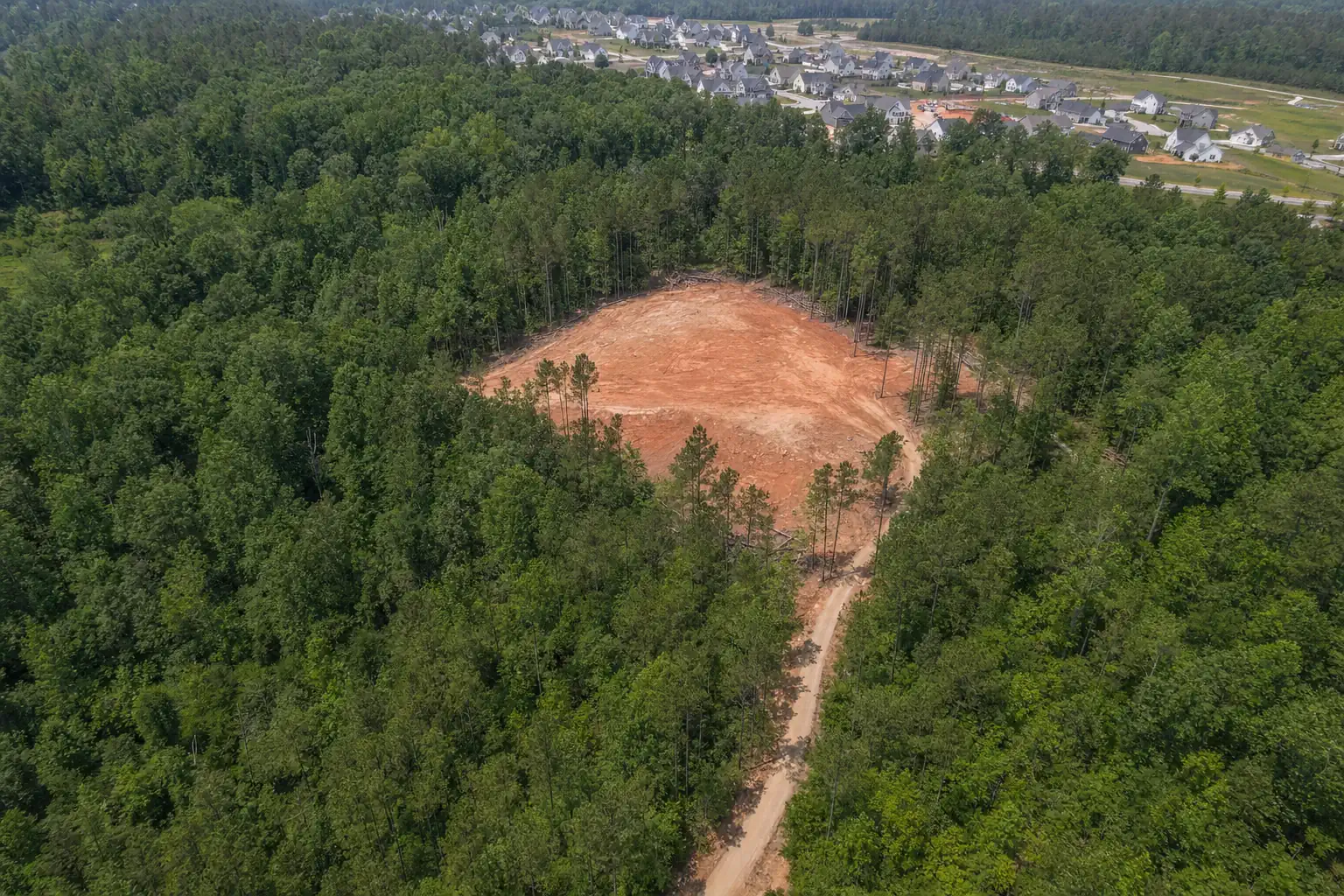
Most land around Cumming is a mix. An old farm tract might have a privet bottom, a pine stand gone to sweetgum underneath and a steep oak draw. We price each piece by its band on the walk, so the quote reflects the ground and not one blended guess. Keeping the big trees and clearing under them often keeps a whole tract in the light band; see underbrush clearing.
Trunk size moves the number most
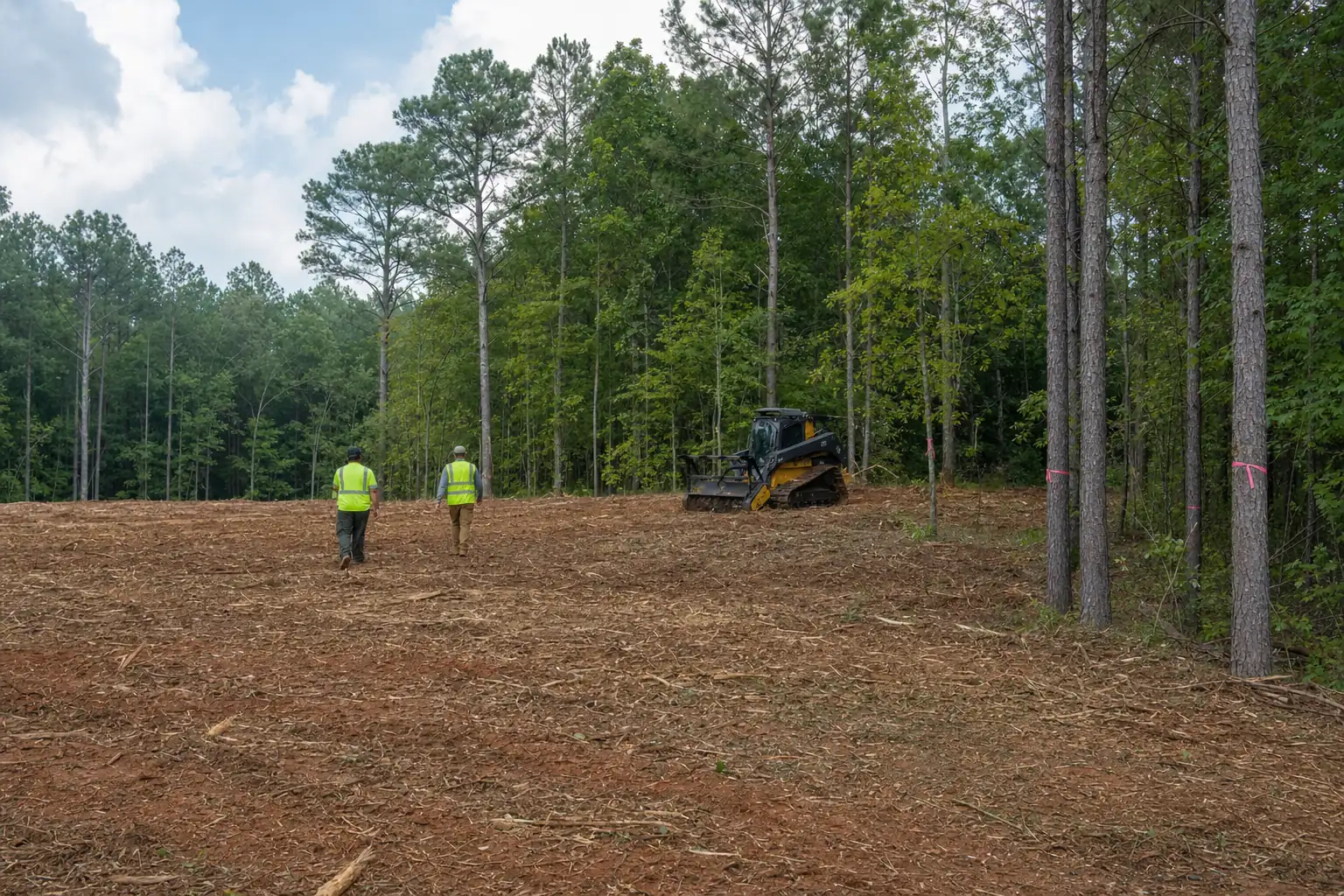
The mulcher’s drum chews a 3-inch sweetgum in seconds and a 10-inch oak in minutes. Contractors call the measure inch-acres: how big the biggest stems are, times how much ground they cover.
- 3.5 hrs
- Machine time per acre where the biggest stems are 4 inches
- 10.5 hrs
- Per acre where they reach 12 inches
- About 8 in
- Largest trunk a mulcher takes standing
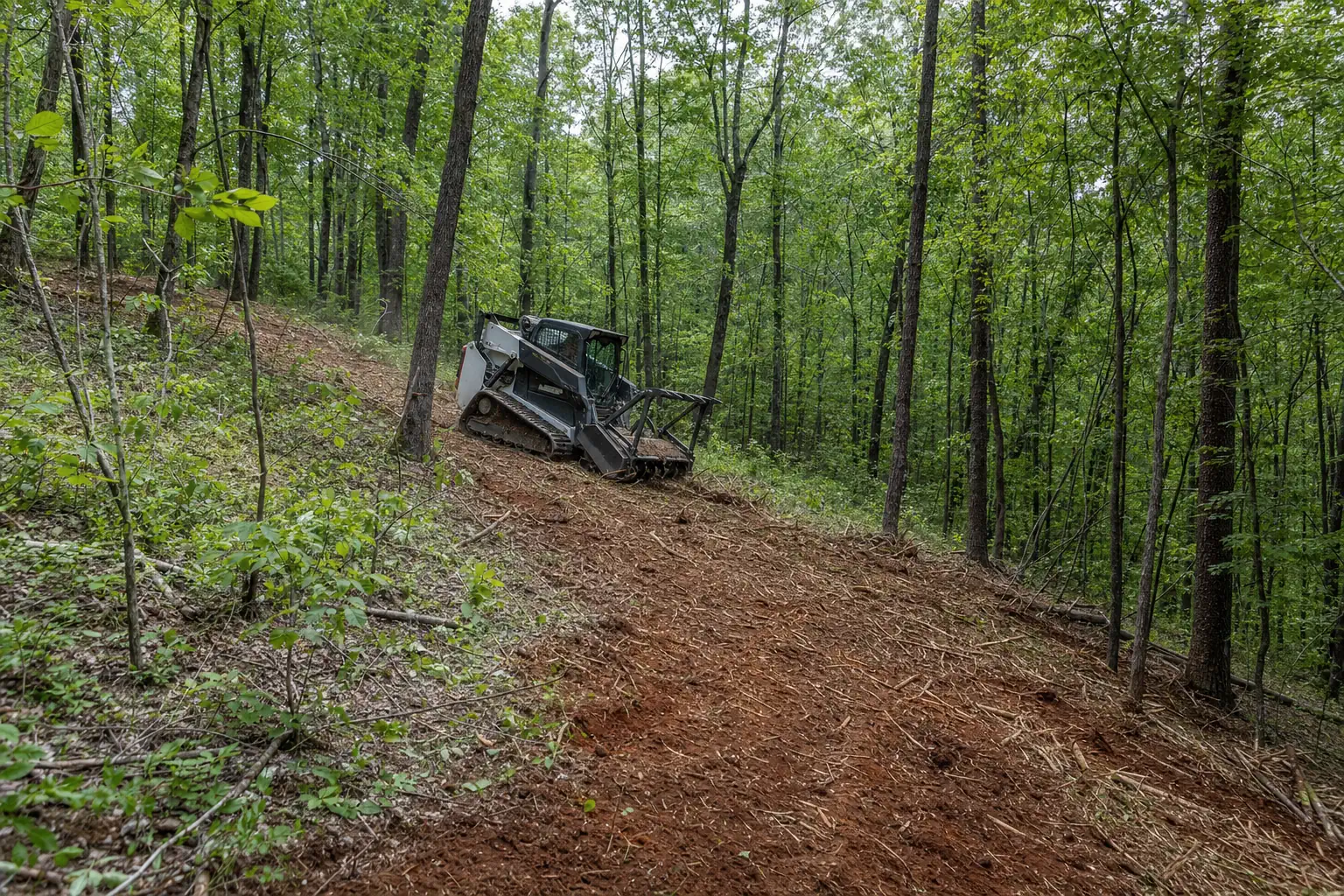
Those two hour figures come from a published production study of forestry mulchers. Past 8 to 10 inches, trees get felled first or kept. After trunk size, the things that move a price are slope and rock, a thick wall of privet against scattered brush, the number of keeper trees to work around, how far the machine walks from the trailer, and whether you want a fine chip for seeding. Wet red clay moves the start date, not the price.
Why bigger tracts cost less per acre
Getting a mulcher to your land costs the same for a half acre as for twenty: a truck, a trailer, an operator and the drive. On a small job that trip is a big share of the bill, so anything around a half acre or less gets a flat minimum. On ten acres it nearly disappears into the per-acre rate.
One machine clears about one to three acres a day of light brush, about an acre of mixed saplings, and less than an acre of dense hardwood. A five-acre underbrushing job is a few days. See what five acres cost and the minimum for a small lot.
What the per-acre price leaves out
- Stumps below grade. Mulching grinds stumps to ground level. Below grade for mowing or planting runs $100 to $400 a stump.
- Stumps out. Under a slab or driveway, an excavator pulls them. That is site preparation.
- Grading. A pad or driveway base runs $1,200 to $3,500 an acre.
- Silt fence. About $500 to $1,200 an acre where a site needs erosion control.
- Hauling. Mulch stays on the ground. Trucking debris away adds $500 to $2,500 an acre.
- Upkeep. Mulched land grows back from the roots. Plan on maintenance mowing once or twice a year.
Forest land and Georgia’s cost-share programs
If you own ten acres or more of forest land, state and federal programs may reimburse named forestry practices on their own schedules, such as understory work and thinning. Each program pays on its own published schedule, has its own eligibility rules and sign-up window, and decides what it covers. Our price doesn’t set the reimbursement. A house lot doesn’t qualify.
Program figures and sign-up windows are set annually and are current as of November 4, 2026. We confirm every figure with the Georgia Forestry Commission or NRCS before any application. This page explains how programs work; it is not a guarantee of eligibility or reimbursement.
We confirm the current terms with the program office before any application. See Georgia’s cost-share programs and does cost-share cover forestry mulching.
Getting the number for your land
Send the address and a few photos of the trunks. We walk it, flag what stays, check slope, creeks and access, and send a written quote in one business day. The rest of the method is on the forestry mulching page.
FAQ
More about mulching costs
- Is forestry mulching cheaper than bulldozing?
- On most land, yes. Mulching runs about $1,200 to $6,500+ an acre and leaves nothing to haul. Clearing, grubbing and hauling with a dozer and excavator runs about $3,500 to $8,000 an acre, and leaves bare clay that needs erosion control.
- Does the per-acre price include stump removal?
- It includes grinding stumps to ground level. Grinding below grade, for ground you'll mow or plant, runs $100 to $400 a stump. Pulling stumps out under a building pad is excavator work and gets priced as site prep.
- Is there a minimum charge?
- Yes. Jobs of about a half acre or less are priced as a flat job, usually $1,200 to $2,000, because hauling the machine out costs the same whatever the size.
- Will Georgia pay for part of my mulching?
- Possibly, if you own ten acres or more of forest land. State and federal programs reimburse named forestry practices on their own published schedules. A house lot doesn't qualify. We confirm the current terms with the program office before any application.
Keep reading