Hunting & Timber · 6 min read
Shooting Lanes and Screening Cover Without Wrecking the Woods
On North Georgia hunting land, flag the bedding areas and screening cover before anything gets cut. Then cut two or three narrow shooting lanes from each stand, angled across the trails deer use, and route access trails around the cover. Clearing everything a machine can reach leaves tidy woods that hold fewer deer in daylight.
Lanes, trails and cover, flagged with you. Quote in one business day.
The tract that got too open
A version of this story comes up on hunting land walk-throughs. An owner hires a machine for a weekend and asks for “some lanes.” The operator is paid by the hour and the woods are thick, so he keeps going. By Sunday you can see from the road to the creek bottom. The deer that crossed the ridge at first light start crossing it after dark, and the owner calls to ask how to fix it.
The fix is mostly time, and a plan for next time. A mulcher can open a lane in an hour. The screening cover it took out takes a season or two to grow back. So on hunting land we decide what stays before we decide what goes.
Flag what stays before anything gets cut
On the walk we mark the keep areas first, with a different flag color from the cut lines. The operator sees both on the ground and works between them.
- Bedding areas. The thickets, briar tangles and young pine stands where deer lie up during the day. On a Forsyth County tract that is often the privet and honeysuckle along a creek bottom. Machines stay out.
- Screening cover. The thick growth that hides the plot, the trail and the stand from deer and from people.
- Travel routes. The saddles, creek crossings and worn trails deer use between bedding and feed. Stands and lanes get set to watch them, not to cut through them.
Only after those are flagged do we mark the openings: the lanes off each stand, the access trail and any plot. The full order, from bedding areas to the last lane, is in the guide to laying out trails, shooting lanes and screening cover.
Shooting lanes: cut from the seat, kept narrow
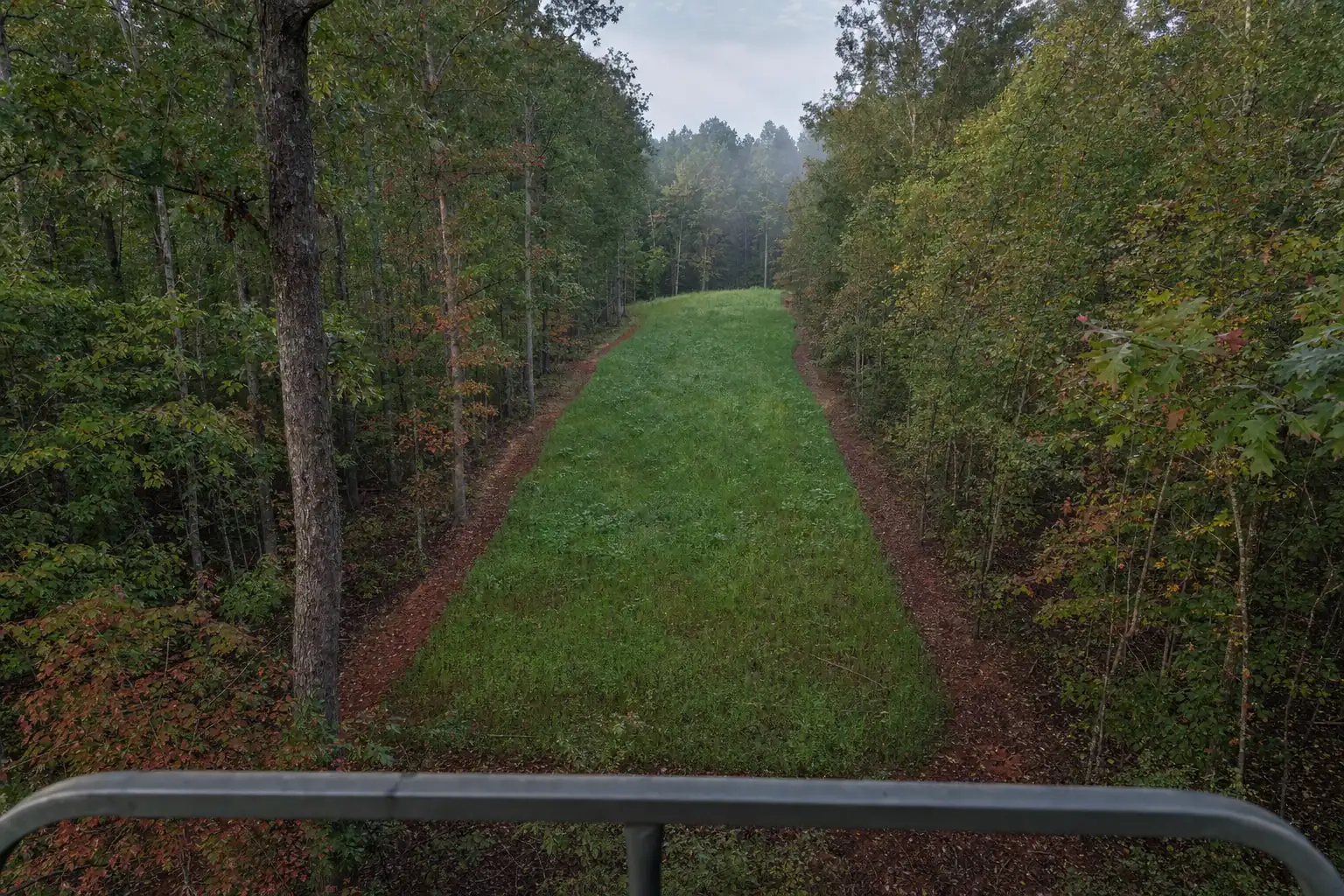
We set lane lines with you sitting in the stand, or standing at the base of a ladder, looking down the trails you plan to watch. A good lane crosses a travel route at an angle, so a deer steps into it broadside instead of walking straight down it toward you.
Width is where most lanes go wrong. A deer should cross a lane in a step or two. Cut a lane to the width of the machine plus a margin on each side and it reads to deer like a road, and they cross it at a run or after dark. Two or three narrow lanes per stand usually cover the trails worth watching.
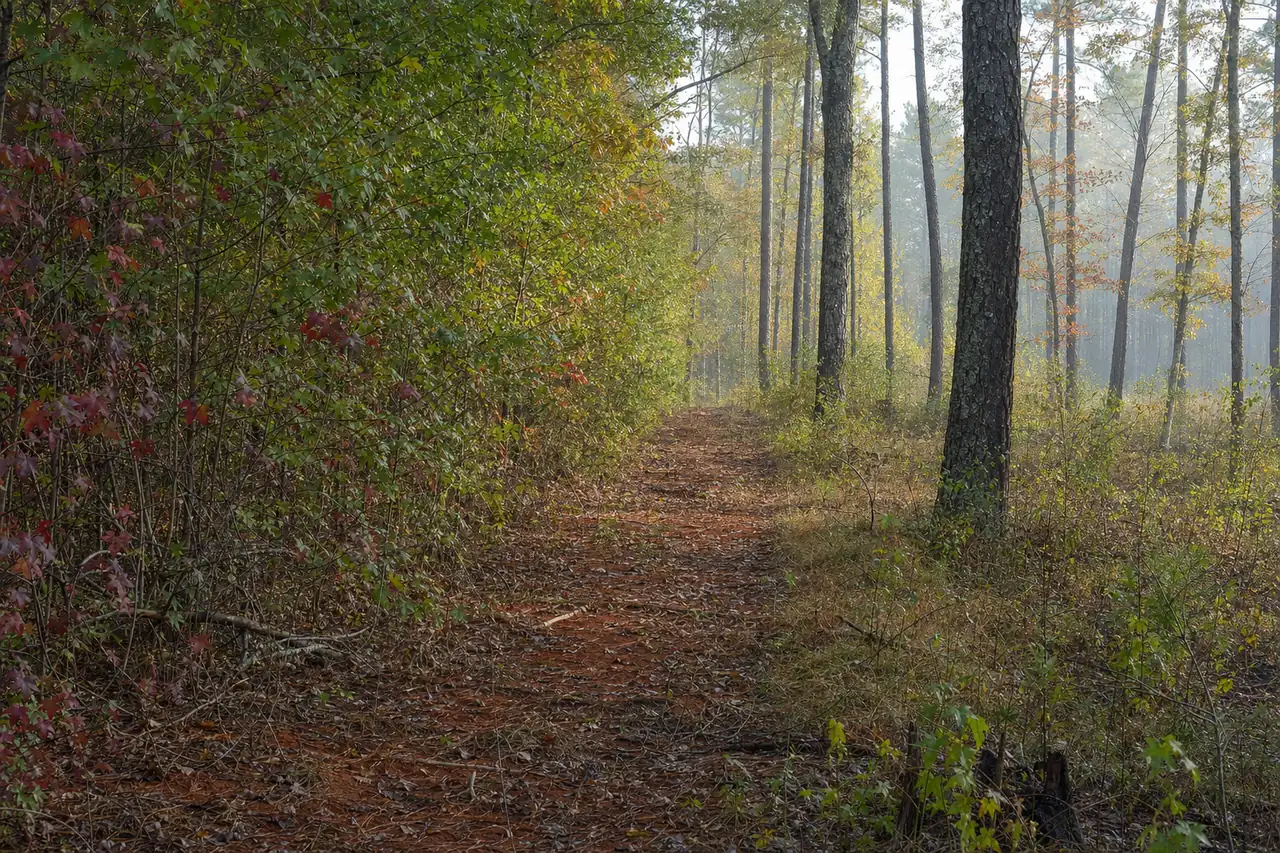
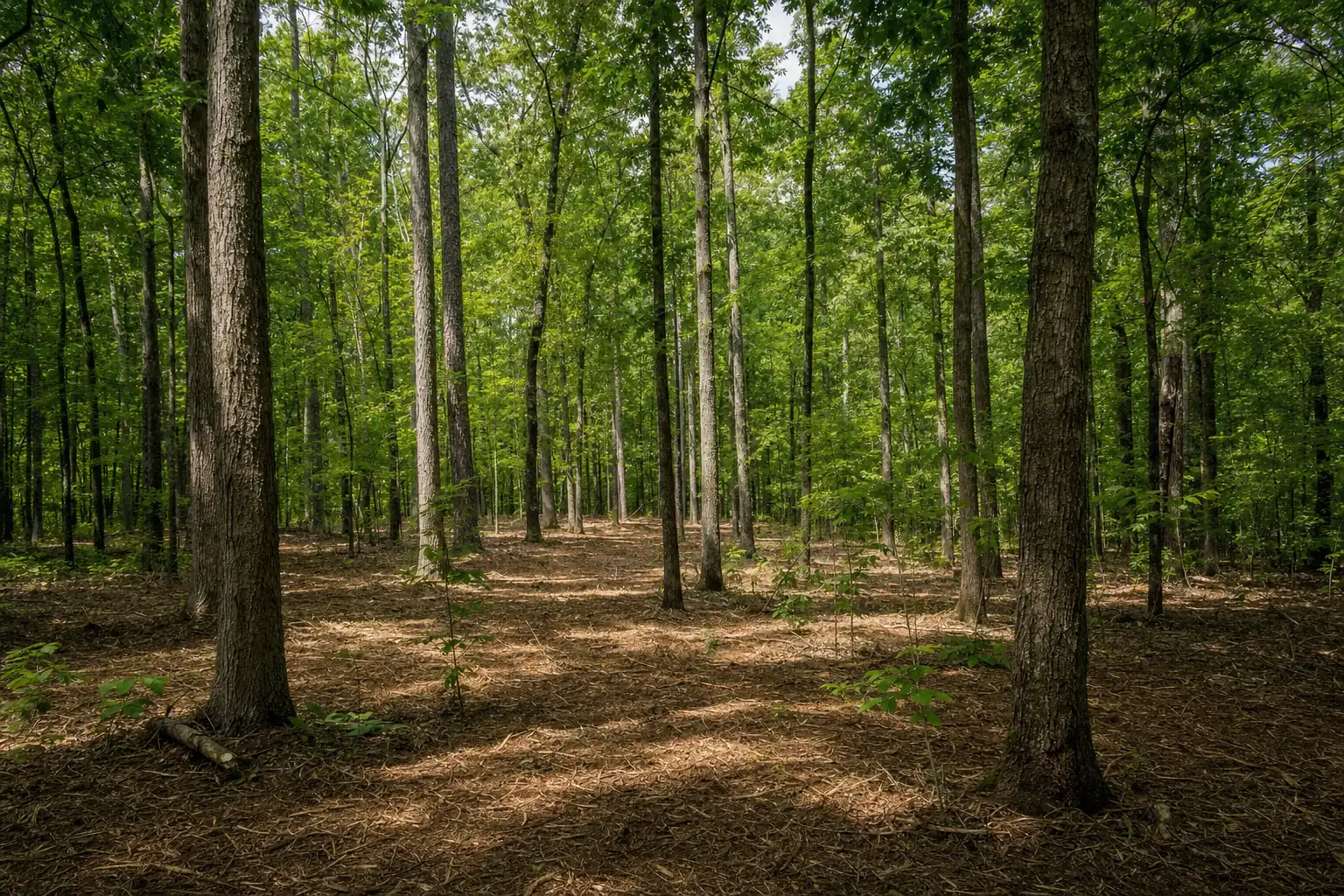
Inside the lane the mulcher grinds the brush, privet and saplings and leaves the big trees standing unless one blocks the shot. What you end up with looks like a strip of underbrushed woods: a mulch floor, the canopy overhead, and a line of sight you didn’t have before.
Screening cover: where it earns its place
Screening cover is the part of a layout people cut by mistake, because it looks like the same brush as everything else. These are the places we leave it thick:
- Along roads and drives. Deer won’t use a plot in daylight if they can see trucks from it, and you don’t want the plot visible from the road.
- On the neighbor line. Cover there keeps your stands out of view and the deer on your side.
- Around the plot edge. A soft, brushy edge gives deer cover to step out from. A clean edge of open woods holds them back until dark.
- Beside the last stretch of trail. The walk into the stand should run through cover, so deer near the plot can’t watch you climb in.
Mulching the whole floor under the timber makes the woods look tidy and holds fewer deer in daylight. More on that in is forestry mulching good for deer habitat?
Questions we ask on the walk
When a piece of ground could go either way, these questions usually settle it.
| Question | If the answer is yes |
|---|---|
| Can you see this spot from the road or the drive? | Keep the cover between it and the road |
| Do deer bed in it during the day? | Mark it and keep the machine out |
| Does the walk to the stand cross it? | Route the trail around it, through cover |
| Would a deer cross it in one or two steps? | Narrow enough for a lane |
| Does a big tree block the only shot? | Fell that tree, keep the rest of the canopy |
| Is it a solid privet wall with nothing under it? | A forester may prescribe opening part of it, planned on its own |
Trails that don’t give you away
An access trail gets you and an ATV to the stand without crossing the ground deer use. We route it in from the downwind side, keep it off the plot, and take it around bedding areas even when the straight line is flatter. On Piedmont slopes it follows the contour, with water bars on every grade so the red clay doesn’t gully. Where a creek has to be crossed, we plan one crossing and keep the trail out of the streamside zone everywhere else.
Trail work can need county paperwork. Forsyth County requires a land disturbance permit for disturbing an acre or more, or for work within 200 feet of a creek, unless an exemption such as forestry applies. The county also holds a 50-foot undisturbed buffer plus a 25-foot setback along streams. We check your trail routes against those lines on the walk; the detail is in can you cut an ATV or walking trail without a permit?
Permit thresholds, fees and buffer widths are those published by Forsyth County and the State of Georgia as of November 4, 2026. Confirm current requirements with the issuing authority before work begins. This is not legal advice.
If the woods are already too open
Leave the strips that should be cover alone. Briars and sprouts fill an open strip within a season or two once nobody mows it, and that regrowth is exactly the thick, low cover you want along a road or a property line. Keep mowing the lanes and the trail, and stop mowing everything else.
The lanes you do want grow back too. Sweetgum, red maple, privet and greenbrier sprout from the roots the spring after clearing, and an unmowed lane closes in within two seasons. One pass each summer, before bow season, holds it. We do that as bush hogging and maintenance mowing, on the same contract as the clearing if you want.
 Food Plot, Trail and Hunting Land Clearing
 Underbrush Clearing: Open the Woods, Keep the Canopy
 Firebreak Installation
What lane and trail work costs
Narrow work spread across a tract usually goes by machine time, since the mulcher spends part of the day moving between stands. A mulcher with an operator runs about $150 to $300 an hour, and a full machine day $1,800 to $3,000. Where lanes and trails add up to real acreage, light brush and saplings price at about $1,200 to $2,500 an acre.
Ranges are estimates for Forsyth County and the surrounding area based on job density, terrain, access and acreage. Your written quote is the only price that applies to your property.
Book the lanes, the trail and any plot on the same trip and you pay to haul the machine once. Do it in late spring or summer, before the season, so nothing runs near your stands in the fall. The rest of our work on hunting tracts is on the hunting and timber land page.